Padi UMKM — A Complexity Case

When I first designed what later became Padi UMKM, I did not do it in a boardroom. I did it at home, during long months of WFH in the middle of the Covid-19 pandemic. I drew the system on papers spread on the floor. At that time, my head was full of ideas about ecosystems, complexity theory, and complexity economics. I was not thinking about building another digital platform. I was thinking about how economic coordination itself breaks down under systemic shock, and how new coordination patterns might emerge when old ones collapse. In that sense, Padi UMKM was born less from a product mindset than from an ecosystem mindset, with complexity theory consciously in the background.

When the pandemic hit, what collapsed was not only the economy. What collapsed was the coordination logic of the economy. Supply chains broke, demand evaporated, SMEs lost access to markets, and institutions discovered that their standard operating procedures were designed for stability, not for systemic disruption. Many organisations reacted by accelerating digital projects, launching platforms, and optimising internal processes. That helped, but it did not address the deeper problem. The economic ecosystem itself had lost its organising structure. Actors that were rational in isolation could no longer produce coherent outcomes collectively. This is how complex systems behave under stress: when established coordination patterns fail, local rationality no longer aggregates into systemic order.

Padi UMKM did not start as a brilliant digital product idea. It started as a response to a coordination failure across a fragmented system of SOEs, SMEs, banks, regulators, ministries, and development agencies. All were acting with good intentions, yet through incompatible logics, timelines, and mandates. The system was not short of initiatives; it was short of coherence. In complexity terms, the economy had been pushed far from equilibrium, and the challenge was not optimisation but reorganisation. What was needed was not another tool, but a new pattern of interaction among heterogeneous agents.

The real innovation of Padi UMKM was therefore not the platform. The platform was the easy part. The digital workforce of Telkom Group can design platforms; that is an operational capability. The platform was necessary, and it became the core infrastructure of the ecosystem, but it was not the breakthrough. The breakthrough was the deliberate redefinition of roles within the economic system. SOEs must reposition their procurement operation into a capability of creating new market, i.e. an SME-based market structure. SMEs were not framed as beneficiaries of aid, but as economic agents that could be structurally integrated into formal procurement and value creation. Banks and financial institutions were not treated merely as lenders, but as part of an enabling architecture that combined financing with capability development and pathways to export. What changed was not a feature set. What changed was the pattern of interaction between economic actors.

The formal launching of Padi UMKM itself was not initiated by Telkom or by the Ministry of SOEs. It was planned within the nationwide BBI (Bangga Buatan Indonesia) program, because the central government needed a real, executable instrument to accelerate domestic economic circulation under crisis. Telkom showed a commitment to develop the platform, even though it was still imperfect at that time. The urgency was national, not corporate. This matters, because it positioned Padi UMKM from the beginning not as a corporate product launch, but as a systemic intervention embedded in a national recovery narrative. The early external promotion of Padi UMKM, beyond the internal SOE environment, was also driven by the BBI program. Over time, almost by systemic selection rather than by design, Padi UMKM became the de facto e-commerce infrastructure for BBI, as other platforms could not fit the specific institutional and ecosystemic roles required by the program.

From the beginning, we made a counterintuitive choice in the way the system was governed. Telkom deliberately limited its role to being the product and platform owner. The ecosystem itself was not branded as Telkom’s program. The community was symbolically owned by the Ministry of SOEs and by SOEs collectively. Even the name Padi UMKM did not originate from Telkom. This was not a political compromise; it was a strategic design choice grounded in complexity thinking. In complex systems, ecosystems tend to collapse when one actor over-claims ownership. When the platform owner also claims to own the ecosystem, other actors reduce their commitment, hedge their participation, or quietly resist. By stepping back from symbolic ownership, Telkom created space for other institutions to step forward. The platform provided the infrastructure, but the legitimacy of the ecosystem was deliberately distributed across actors.

At some point, something structurally interesting happened. The initiative crossed a threshold where no single actor could kill it anymore. The CEO of Telkom could not simply shut it down because the ecosystem had become institutionally embedded beyond Telkom. The Minister of SOEs could not dismantle it easily because it had become part of the official narrative of national economic recovery. The President could not disown it because it had been publicly positioned as a success story through BBI, PEN, and related programs. This was not political theatre. This was the moment when the system acquired path dependence. Once an initiative becomes embedded across multiple layers of institutional narrative and governance, it ceases to be a project and becomes part of the system itself. At that point, you are no longer managing a prograe. You are dealing with a living economic structure.

Value in Padi UMKM did not come from transactions alone. It emerged from the coupling of multiple layers of interaction. Transactions between SOEs and SMEs were reinforced by access to credit, by certification mechanisms that enabled formal participation, by development programmes that upgraded SME capabilities, and by pathways to export markets. None of these elements, on their own, would have been transformative. The transformation emerged from their interaction. This is how complex economies create value: not through linear pipelines, but through ecosystems in which different forms of capital, i.e. financial, institutional, social, and operational, reinforce one another over time.

Internally in Telkom, there was a structural separation of roles that proved critical. The Digital Business Directorate (DDB) operated at the product and business level. Its logic was operational: build, run, scale, monetise, and maintain the platform. Even as the platform owner and economic keystone, it remained only one agent within the broader ecosystem. In parallel, the Synergy Subdirectorate under the Strategic Portfolio Directorate worked at the ecosystem level. This role was not about features, roadmaps, or KPIs. It was about sensing emergent patterns of collaboration, mediating conflicts between institutions, and navigating collisions between policy signals and organisational incentives. In the early phase, the Synergy team also played a foundational role in organising cross-SOE agreements, preparing the multi-actor launch, embedding Padi UMKM within the BBI program, and connecting it with multiple SME build-up initiatives involving the Ministry of SMEs, the Ministry of Trade, and other institutions. This work was not linear project management; it was ecosystem orchestration under uncertainty.

In Indonesia’s context, the interaction between SOEs, SMEs, banks, and regulators is not merely complex; it is quasi-chaotic. Mandates overlap, incentives conflict, and policies evolve at different speeds and under different political pressures. In such an environment, precise prediction is an illusion. What becomes possible instead is navigation: sensing where constructive patterns of emergence are forming, dampening destructive feedback loops before they escalate, and shaping the boundaries within which the ecosystem evolves. This is not classical management. This is leadership under complexity.

As a result of its early success, there was a moment when the government, again through the BBI programme, asked to expand Padi UMKM to cover all government agencies (K/L/PD). On paper, this looked like success, with an enormous projected GMV. In reality, it carried a systemic risk. Full integration into the broader government procurement apparatus would have imposed rigid compliance structures and administrative constraints that could have frozen the adaptive dynamics that made the ecosystem work. The decision to return that expansion to LKPP, while positioning Telkom only as a platform provider for LKPP, was a deliberate choice to preserve modularity and flexibility over symbolic scale. In complex systems, scale without adaptability is not growth; it is fragility disguised as success.

What this experience ultimately taught us is uncomfortable for traditional management thinking. In complex economic ecosystems, you cannot engineer outcomes. You can only design conditions: boundaries, incentives, roles, and narratives that make constructive emergence more likely than destructive collapse. The platform mattered. The technology mattered. But what mattered more was the humility to accept that once an ecosystem becomes alive, you are no longer the architect standing outside the system. You are one of the agents operating within it.

The strategic lesson for C-level leadership is this. In times of systemic disruption, competitive advantage no longer lies primarily in having the most sophisticated product or the fastest execution. It lies in the capability to shape interaction spaces across institutions, sectors, and policy domains. Leadership shifts from control to stewardship. Strategy shifts from optimisation to navigation. And success is no longer measured only by ownership, but by whether the system you helped catalyse can survive, adapt, and continue to create value even when you step back.

That, ultimately, is what Padi UMKM represents. Not a digital product success story, but a case of how leadership, strategy, and technology can be recomposed to operate effectively in a complex, adaptive economy under crisis. It is an ecosystem in motion. It is Synergy in action.
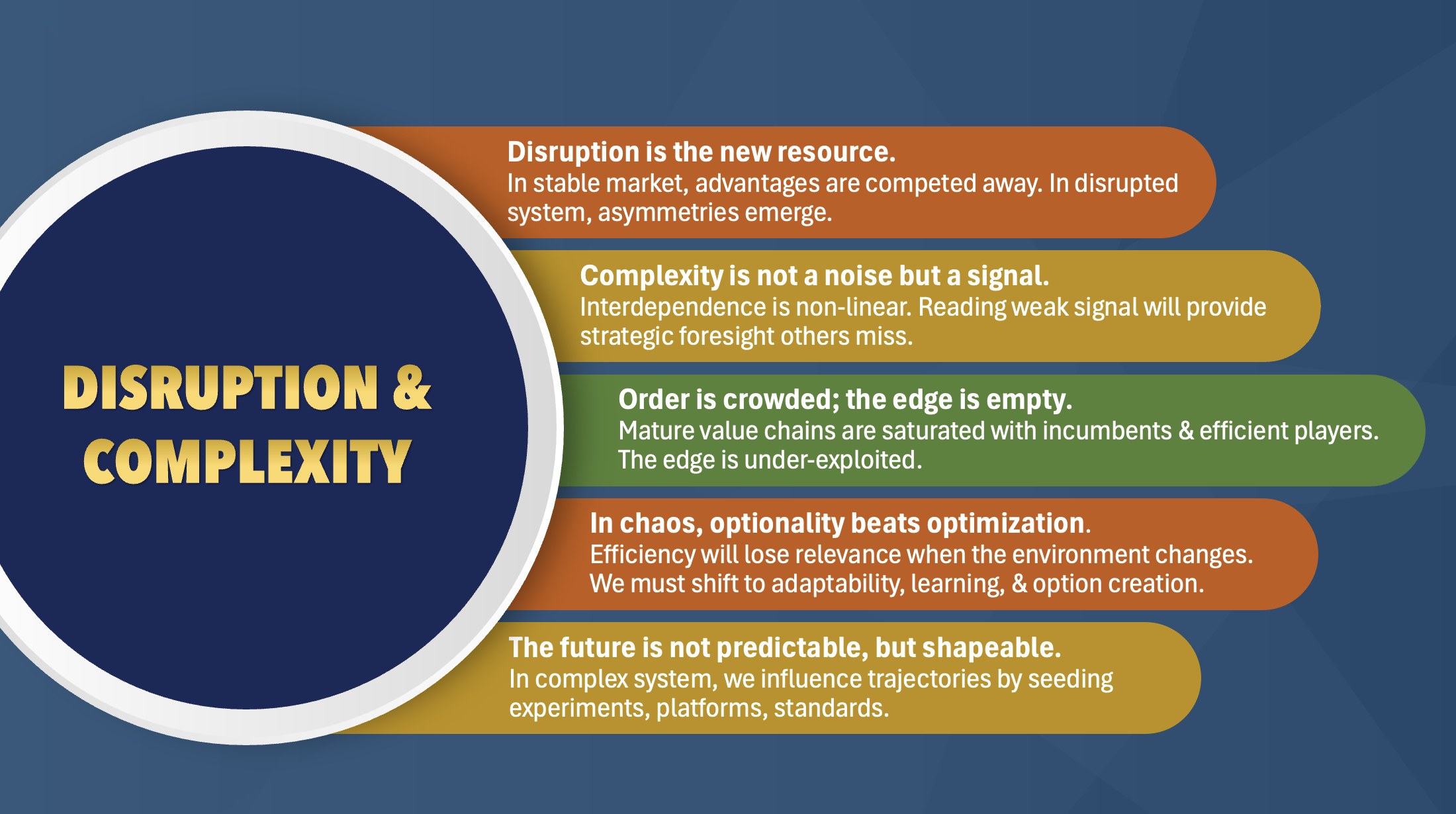
Navigating Business at the Edge of Chaos

This is a speech preparation for the CIMA & AICPA Strategic Leaders Breakfast Talk, to be held in mid-February 2026, under the theme ‘Leadership in the Age of Disruption — Strategic Leadership for Modern Finance Professionals’. I will deliver the presentation from the perspective of complexity science and complexity economics, before exploring the practical implementations for management accounting professionals.

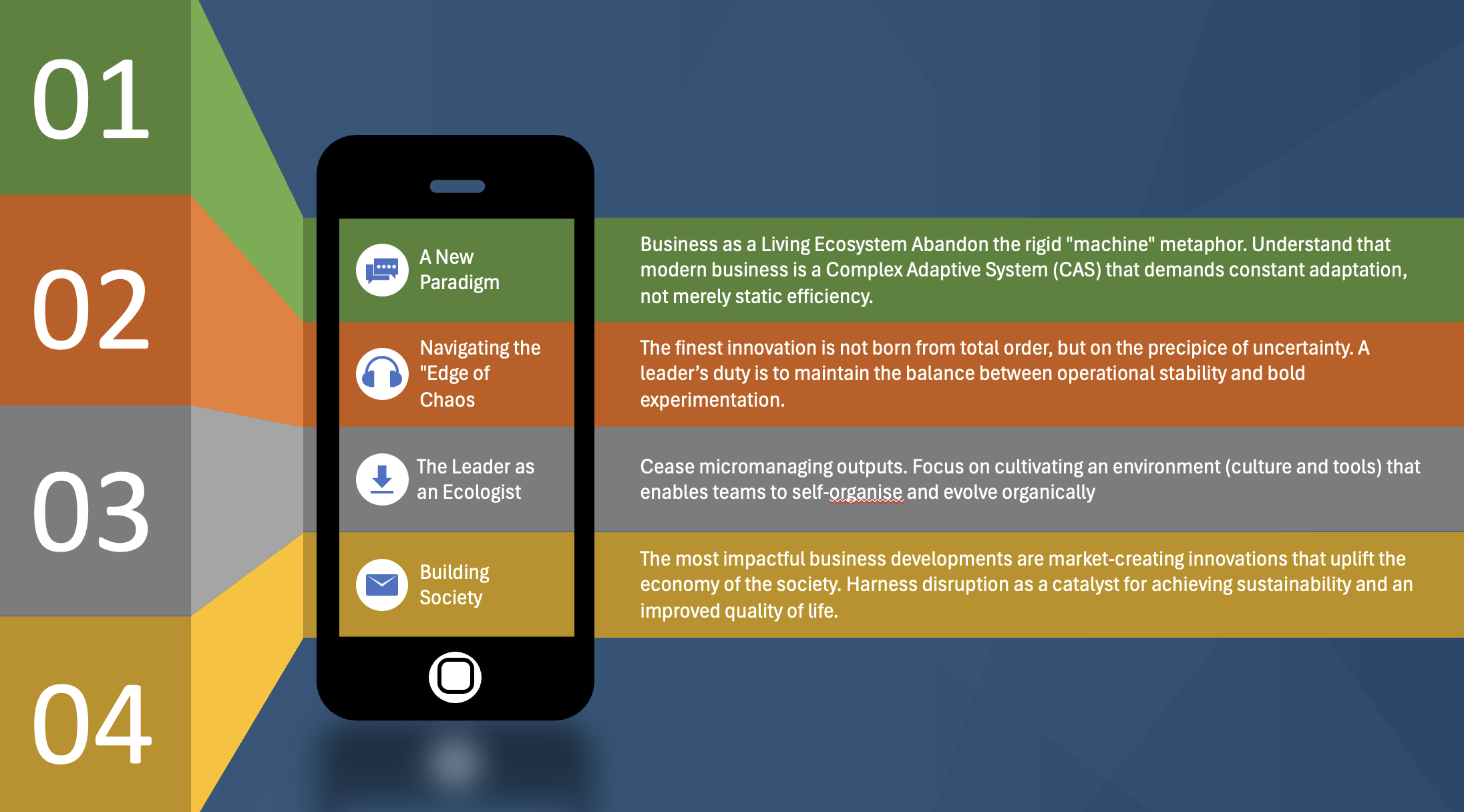
In current economic landscape, business must be perceived as the development of an ecosystem that operates as a complex adaptive system (CAS). Within this framework, autonomous agents, both internal to the firm and across broader business networks, possess the capacity for independent decision-making and activity. From this complexity perspective, phenomena such as VUCA (Volatility, Uncertainty, Complexity, and Ambiguity) and disruption are no longer viewed as external threats to be mitigated or overcome. Instead, they are recognised as engines of evolution and qualitative opportunities to redesign business architecture. Strategy shifts from the mere optimisation of saturated, linear models toward the cultivation of dynamic ecosystems that generate new value through the process of emergence.

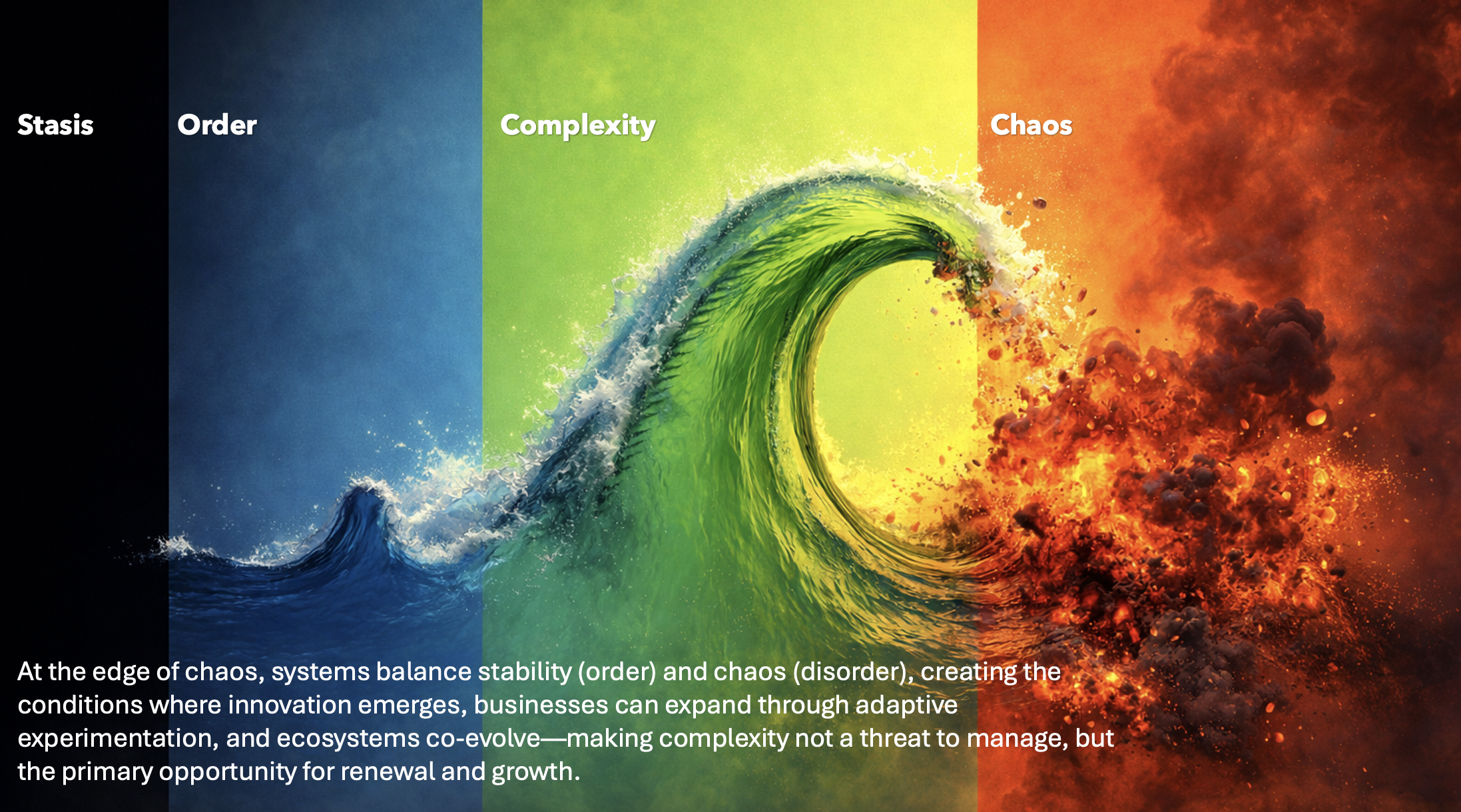
The optimal zone for such innovation is the Edge of Chaos, which is a critical transition state where a system balances order and stability with disorder and change. It is precisely in this zone, rather than in a state of total equilibrium, where optimal innovation occurs. For the modern enterprise, the Edge of Chaos is not a threat to be avoided, but a strategic space to be occupied and, if necessary, intentionally created. Competitive advantage in this regime is defined not by scale or static efficiency, but by architectural flexibility and the velocity of learning in response to constant internal and external feedback loops.

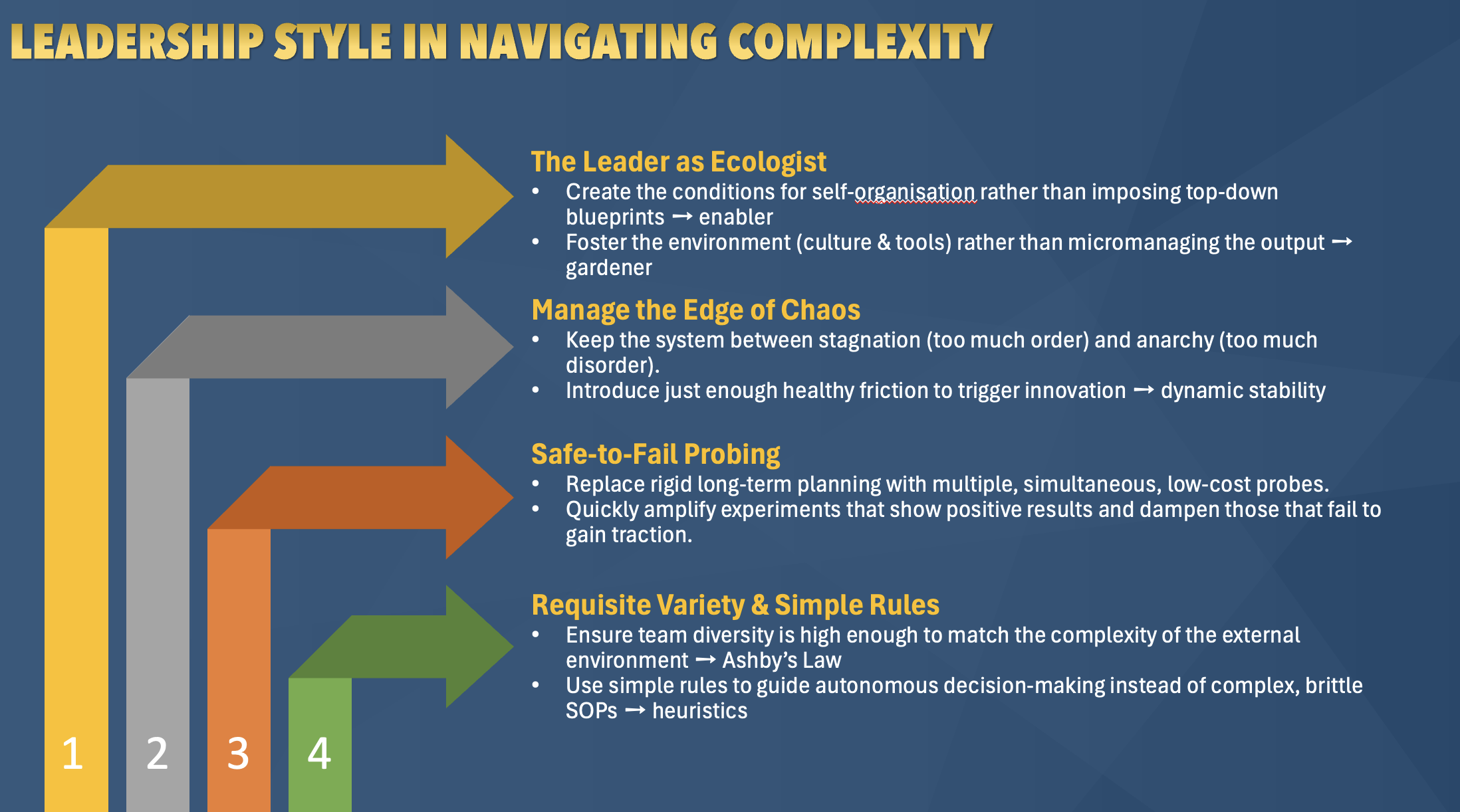
Leadership within this complex environment requires a fundamental shift in identity toward that of an ecologist. The leader’s primary duty is no longer the top-down control of outputs, but the creation of conditions and cultures that enable teams to self-organise. This involves managing the delicate tension at the Edge of Chaos, introducing enough healthy friction to trigger innovation without descending into systemic anarchy. Rigid & brittle SOPs are replaced by simple rules or heuristics that guide autonomous decision-making amidst ambiguity. Leaders must facilitate safe-to-fail probing, i.e. launching multiple, simultaneous, low-cost experiments to detect strategic signals and opportunities that traditional analytical models inevitably miss.

Strategic management in the exponential era demands ambidextrous design, balancing the exploitation of core operations with the continuous exploration of new ventures through modular structures. This necessitates the orchestration of resources far beyond traditional organisational boundaries, incorporating partners, start-ups, and regulators into platform-based strategies. Strategy is viewed as a process of co-evolution, where the organisation constantly reinvents itself to remain congruent with a shifting environment.

Finally, Management Accounting (MA) serves as the vital navigation instrument in this journey through the Strategic Planning for Exponential Era (SPX) framework. MA must evolve to support dynamic feasibility, utilising Real Options Analysis to value investments as strategic options—the right to expand, delay, or pivot—rather than rigid, one-way capital bets. This implementation includes Agile Capital Budgeting, where funds are allocated to strategic “buckets” rather than granular, unproven projects. By abandoning the stagnation of rigid annual budgets in favour of Rolling Forecasts and Throughput Accounting, MA ensures that resource allocation is driven by real-time feedback and the velocity of value conversion. Ultimately, the most profound business developments are market-creating innovations that not only ensure sustainability but actively uplift the economy and quality of life for society

Tantangan EUDR

Uni Eropa adalah konsumen kopi terbesar di dunia dengan serapan 2,4 juta ton per tahun, dan merupakan pasar yang paling menentukan reputasi kualitas kopi Indonesia secara global. Belgia (Antwerpen, pelabuhan kopi terbesar dunia) dan Jerman bersama-sama menyerap hampir 46 juta kilogram per semester I 2025 — nyaris menyamai Amerika Serikat sebagai pasar tunggal terbesar. Secara keseluruhan, sekitar 23 persen nilai ekspor kopi nasional mengalir ke pasar EU. Dua segmen produk yang dibeli Eropa sangat berbeda karakternya: robusta curah dalam volume besar yang masuk ke industri roasting dan instant Eropa melalui Belgia, dan arabika specialty dengan harga premium yang diserap langsung oleh roastery di Jerman, Belanda, dan Skandinavia. Di segmen robusta, Vietnam sudah secara konsisten menggeser posisi Indonesia dengan efisiensi rantai pasok yang lebih superior dan dukungan pemerintah yang lebih kuat, terbukti dari pertumbuhan ekspor Vietnam ke Eropa sebesar 32,8 persen pada 2024 ketika Indonesia justru turun 66 persen.

European Union Deforestation Regulation (EUDR, Regulation EU 2023/1115) mewajibkan setiap produk kopi yang masuk pasar EU dapat dilacak sampai ke plot lahan spesifik tempat produksinya, dilengkapi koordinat geospasial terverifikasi, bukti tidak ada deforestasi sejak 31 Desember 2020, kepatuhan terhadap hukum produksi negara asal, dan Due Diligence Statement yang disubmit ke sistem EU TRACES. Regulasi ini berlaku untuk perusahaan besar sejak 30 Desember 2025, dan untuk usaha kecil dan mikro mulai 30 Juni 2026. Tantangan terbesar Indonesia bukan soal apakah kebun kopi rakyat benar-benar melakukan deforestasi, melainkan soal kemampuan membuktikannya secara digital dan terdokumentasi. Sekitar dua juta petani kecil tersebar di pegunungan terpencil tanpa data GPS, tanpa sertifikat lahan formal, terhubung melalui rantai pengumpul yang tidak mencatat asal-usul lot secara terpisah, dengan infrastruktur internet yang sangat terbatas. Ini bukan sekadar masalah teknis. Ini adalah masalah ekosistem data yang tidak pernah dibangun.

Dampaknya berlapis dan meluas jauh melampaui pasar Eropa. Di tataran langsung, lot kopi tanpa DDS valid akan tertahan di pelabuhan; buyer Eropa akan meminta diskon “compliance risk”; dan eksportir kecil tanpa sumber daya untuk membangun sistem traceability akan tersingkir, terkonsolidasi, atau bergantung sepenuhnya pada aggregator besar. Secara global, regulasi serupa sedang diadopsi oleh Inggris, dengan potensi diikuti AS dan Jepang. Artinya kegagalan membangun infrastruktur data sekarang menjadi masalah sistemik di seluruh pasar premium. Dampak domestiknya sama seriusnya: petani yang tidak bisa comply akan terdegradasi ke pasar lokal dengan harga lebih rendah; tengkulak dengan model bisnis lama (beli campuran tanpa dokumentasi) tidak bisa survive; dan kopi yang gagal standar EUDR akan membanjiri pasar domestik, menekan harga lokal justru ketika biaya produksi naik. Estimasi makro skenario terburuk untuk seluruh komoditas terdampak mencapai potensi kerugian output nasional Rp203,8 triliun dan 820 ribu lapangan kerja.

Tiga jalur pemecahan harus dijalankan secara paralel, bukan berurutan.

  • Di jalur regulasi, Indonesia perlu mengintensifkan diplomasi ekonomi melalui forum JTF Indonesia-Malaysia-EU dan perundingan IEU-CEPA untuk mendapatkan perlakuan khusus bagi smallholder, sekaligus mencegah Indonesia diklasifikasikan sebagai “high risk country” dalam sistem country benchmarking EU — klasifikasi ini akan menambah biaya dan waktu pemrosesan semua kargo secara dramatis.
  • Di jalur bisnis, strategi paling fundamental adalah mengubah narasi dari “hambatan” menjadi “sertifikat kepercayaan”: kopi Indonesia yang EUDR-compliant berhak mendapat premium pricing 15–30 persen, dan koperasi perlu diposisikan sebagai trusted compliance node yang mewakili ratusan petani anggota dalam satu DDS. Diversifikasi pasar ke Asia Timur dan Timur Tengah bukan mundur dari Eropa — melainkan memperkuat posisi tawar dengan memiliki alternatif yang tidak bergantung pada satu regulasi.

Teknologi traceability yang dibutuhkan bekerja dalam empat lapisan yang saling bergantung.

  • Lapisan pertama adalah GPS dan mobile geo-mapping: aplikasi smartphone offline-first yang memungkinkan petugas koperasi merekam koordinat plot lahan petani, foto kondisi lahan, dan status kepemilikan; dengan model proxy data entry yang mengatasi keterbatasan literasi digital petani.
  • Lapisan kedua adalah satellite monitoring berbasis AI: citra Sentinel-2 (Copernicus, gratis) dan Planet Labs dibandingkan dengan baseline 31 Desember 2020 menggunakan model machine learning untuk memverifikasi tidak ada deforestasi, dan menghasilkan risk score per plot secara otomatis.
  • Lapisan ketiga adalah blockchain sebagai infrastruktur kepercayaan: berbeda dari database biasa, blockchain menjamin immutability, transparansi multi-pihak, dan audit trail permanen yang tidak bisa dimanipulasi. Ini adalah properti yang esensial untuk meyakinkan regulator EU dan buyer internasional.
  • Lapisan keempat adalah otomasi DDS: platform compliance seperti TraceX, IntegrityNext, atau Dimitra Connected Farmer yang mem-parse seluruh data dari ketiga lapisan sebelumnya dan meng-generate Due Diligence Statement secara otomatis untuk disubmit ke EU TRACES via API. IoT (sensor di wet mill, smart scale, GPS tracker kendaraan) memperkuat kualitas dan autentisitas data di titik-titik agregasi, sementara AI di luar satellite monitoring berperan dalam anomaly detection, risk scoring, NLP untuk digitisasi dokumen fisik, dan reduksi manual effort secara keseluruhan.

Kita dapat mensimulasikan timeline realistis untuk implementasinya, dalam empat fase berikut.

  • Fase pertama (sekarang hingga Juni 2026) adalah crisis response: mapping darurat untuk 50.000+ petani di sentra ekspor prioritas, pilot full compliance cycle di 5–10 koperasi besar Gayo dan Toraja, dan intensifikasi lobbying country benchmarking.
  • Fase kedua (Q3 2026–Q2 2027) adalah infrastructure build: scale-up ke 300.000–500.000 petani, peluncuran platform traceability nasional oleh Ditjenbun, dan sertifikasi nasional “EUDR Ready” yang dinegosiasikan ke EU sebagai simplified compliance pathway.
  • Fase ketiga (2027–2028) adalah competitive advantage: full coverage di atas 1,5 juta petani, Digital Product Passport berbasis QR blockchain menjadi standar ekspor, dan premium pricing mulai ter-capture secara konsisten.
  • Fase keempat (2029+) adalah ecosystem leadership: Indonesia menjadi model referensi global untuk traceability kopi smallholder dan mulai mempengaruhi arah evolusi regulasi internasional dari posisi kepatuhan menjadi co-authorship.

Penentu antara skenario gagal dan berhasil bukan teknologi — teknologinya sudah ada dan sudah terbukti di negara lain. Penentu sesungguhnya adalah koordinasi lintas kementerian, model keuangan yang menanggung biaya compliance secara adil, penguatan koperasi sebagai tulang punggung sistem, dan kecepatan bergerak dalam window waktu yang sudah sangat sempit.

Synergy Value as Emergence

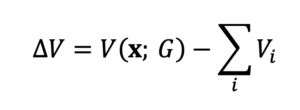
When considering mergers, acquisitions, alliances, or even intra-group synergies, it is useful to shift our perspective away from additive arithmetic and towards the philosophy of emergence. In complex systems, including business ecosystems as complex adaptive systems, value does not reside solely within the parts; rather, it arises through the patterned interactions between them. This emergent phenomenon is precisely what in corporate finance is labelled synergy value. In formal terms, we may describe the total incremental value of a collaboration as

where V(x; G) denotes the value of the whole system, generated by the vector of resources and activities x under a specific governance structure G, and ∑V represents the value of each entity in isolation. The very fact that ΔV may be greater than zero testifies to emergence: complementarities in action, dependencies properly orchestrated, and adaptive patterns unfolding across the system.

The Levers of Emergent Synergy

Four principal levers determine whether emergent value materialises or evaporates. The first is complementarity, or what economists term supermodularity. This describes the situation in which activities reinforce each other such that the marginal return of undertaking one activity is enhanced by the undertaking of another; formally, the cross-partial derivatives are positive (𝛿²V/𝛿xi 𝛿xj > 0). It is here that the popular slogan “one plus one equals more than two” has rigorous grounding.

The second lever is the interdependence structure. Every collaboration has a topology of dependencies, where some assets act as complements, others as substitutes, and some nodes become bottlenecks through which the value of the entire system is channelled. In business ecosystems, mapping this structure is indispensable, for it often dictates whether modularity and flexible linkages suffice, or whether full absorption is required.

The third lever is defined by the adaptive rules of the system. A collaboration is not static; it is a complex adaptive system in which local decisions, feedback loops, and routines create new global patterns. Where local experimentation is permitted, and where feedback loops are properly designed, valuable behaviours diffuse through the organisation or alliance. Where rigidity prevails, the system is condemned to stasis, and synergy remains a theoretical promise rather than an emergent reality.

Finally, there is the matter of orchestration capacity. This refers to the dynamic capabilities of leadership—sensing opportunities, seizing them through resource allocation, and reconfiguring the system as environments change. Ashby’s principle of requisite variety reminds us that the variety of governance and decision-making tools must match the variety and volatility of the environment. Without adequate orchestration, even strong complementarities and favourable topologies may collapse under the weight of integration costs.

Applications Across Collaboration Types

In mergers and acquisitions, the choice of integration model should mirror the degree of interdependence. The celebrated Haspeslagh–Jemison framework reminds us that absorption is not always optimal; linkage or preservation may unlock more emergent value when autonomy is vital. The risk of the so-called synergy mirage lies precisely in misjudging complementarities and ignoring the time it takes for emergent patterns to stabilise. Thus, every acquisition is less a completed transaction than a hypothesis about the future, whose proof lies in the integration process.

In alliances and joint ventures, synergy takes the form of options on emergence. Here, limited commitments allow parties to test complementarities without over-committing capital. The collaborative form is well-suited to contexts of uncertainty, where exploration of emergent patterns is required. Ecosystem logic also applies: co-opetition and the management of network externalities often define the extent of emergent value.

For intra-group business synergy, emergence must be cultivated across corporate units. Here, Herbert Simon’s notion of near-decomposability becomes instructive: groups should design modular interfaces so that subsidiaries adapt locally yet align globally. To maintain cooperation, emergent rents must be shared fairly; cooperative game theory suggests the Shapley value as one method of allocating incremental value in proportion to each unit’s marginal contribution. Without such fairness, group members are tempted to defect, undermining the collaborative potential of the system.

Measuring and Governing Emergence

Because synergy is emergent, it resists simple enumeration. Yet it is not beyond the reach of disciplined measurement. One may begin with a complementarity map, estimating where cross-partials are most positive, and therefore where joint action may yield the greatest return. Alongside, an ecosystem dependency graph may be drawn, in the spirit of Ron Adner’s ecosystem mapping, to reveal missing complements and bottlenecks whose removal could unlock value.

Where uncertainty is high, the logic of real options should prevail. Pilot projects, staged investments, or minority stakes serve as options to explore emergent potential without risking catastrophic downside. Parallel to this, a system of synergy accounting may be implemented, in which incremental value is decomposed using Shapley allocations, thereby aligning incentives with marginal contributions to the whole.

The Philosophical Bottom Line

Synergy lives not in assets but in interactions. Corporate actions—whether a merger, an alliance, or an intra-group initiative—are best understood as interventions in a complex system. When complementarities are strong, interdependencies are designed with care, adaptive rules permit experimentation, and orchestration capacity is sufficient, emergent synergy is more than a hopeful metaphor; it becomes an observable reality. Conversely, where these levers are mismanaged, the promised “1 + 1 > 2” dissolves into disappointment, integration costs, and value destruction.

Thus, the philosophy of emergence, long a staple of complexity science, is not an academic curiosity but a practical guide to business collaboration. It teaches us that the true measure of a deal or alliance lies not in the parts themselves, but in the patterns of interaction that the collaboration enables.