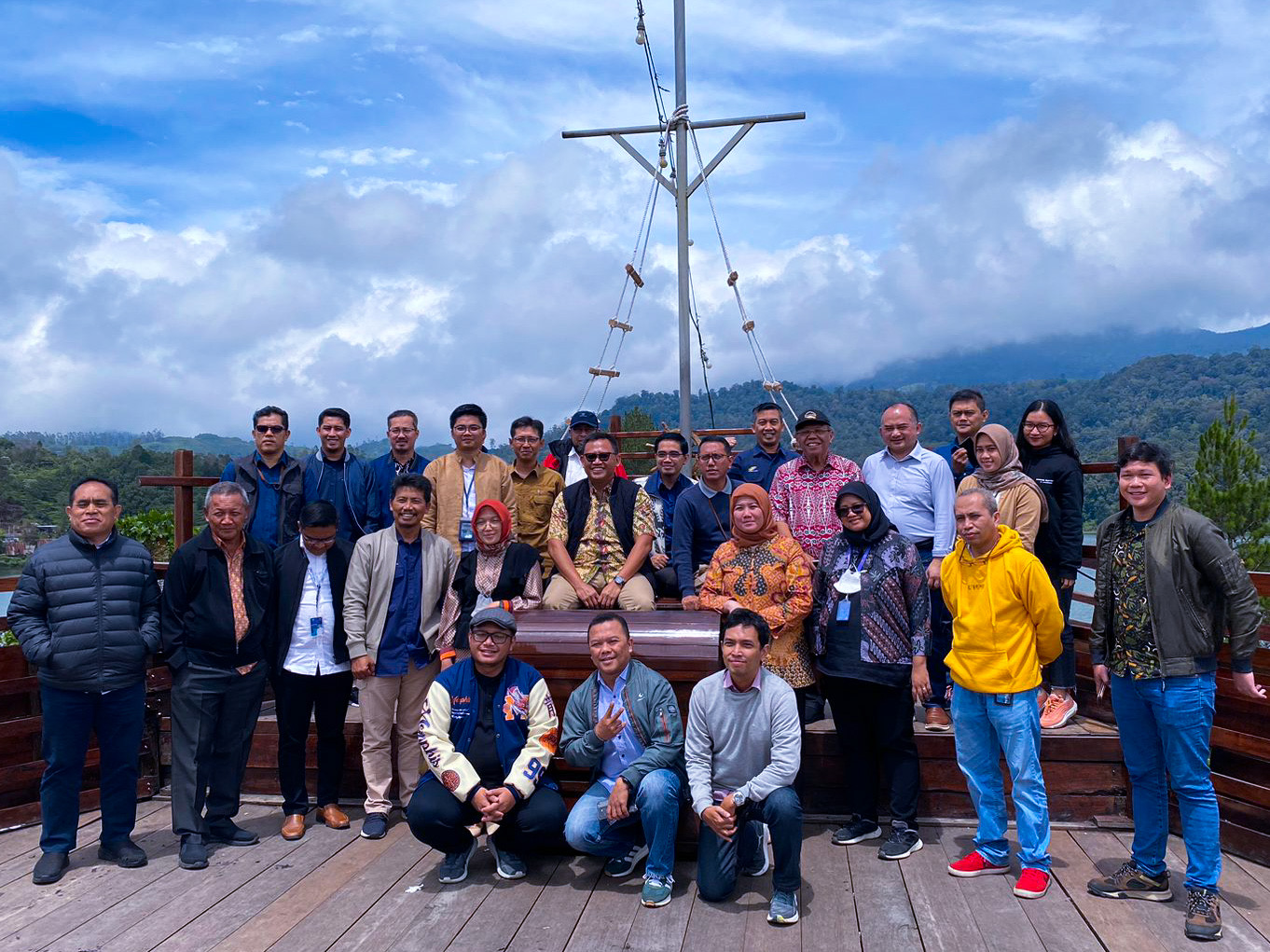
Navigating Business at the Edge of Chaos

This is a speech preparation for the CIMA & AICPA Strategic Leaders Breakfast Talk, to be held in mid-February 2026, under the theme ‘Leadership in the Age of Disruption — Strategic Leadership for Modern Finance Professionals’. I will deliver the presentation from the perspective of complexity science and complexity economics, before exploring the practical implementations for management accounting professionals.

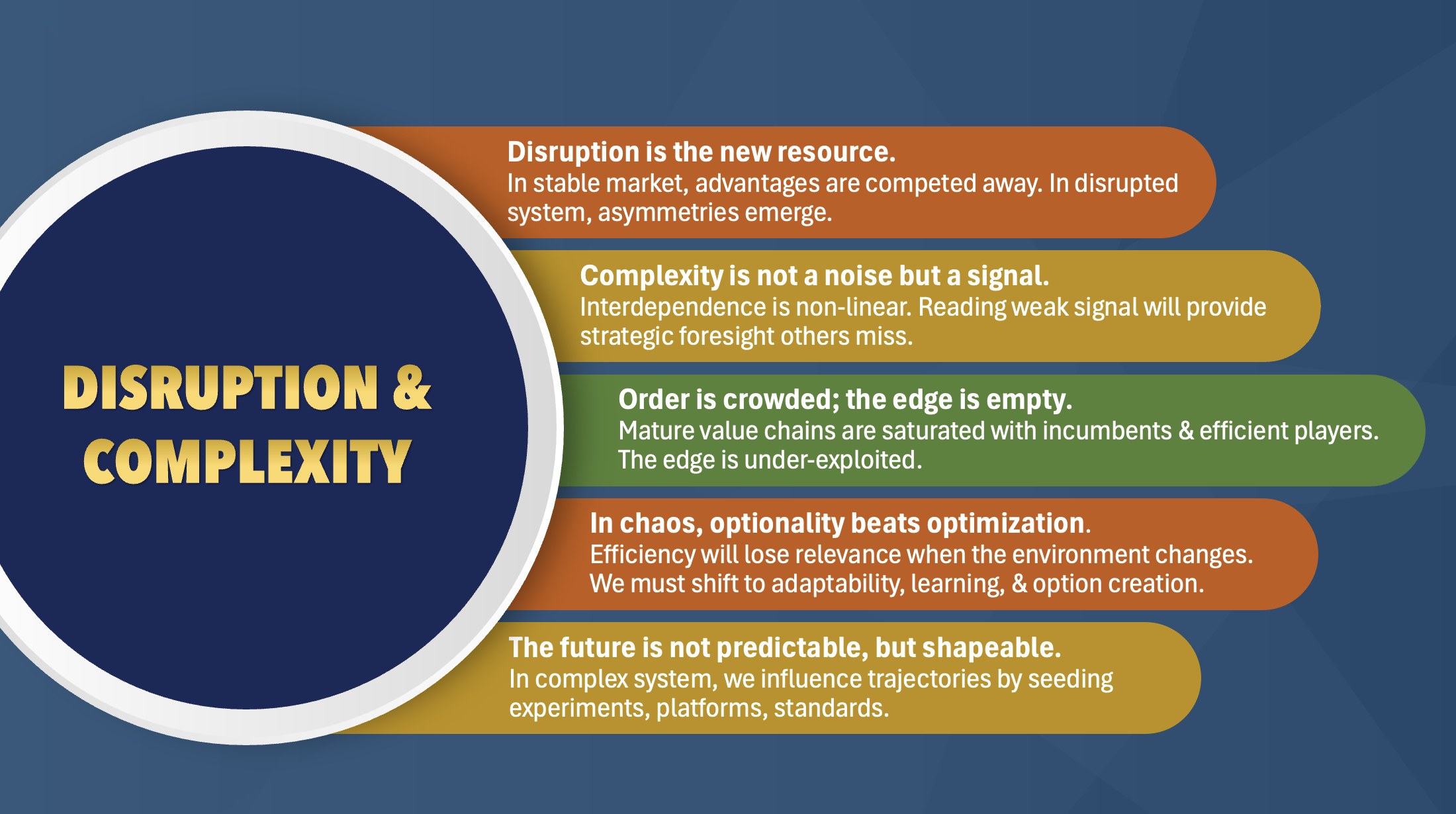
In current economic landscape, business must be perceived as the development of an ecosystem that operates as a complex adaptive system (CAS). Within this framework, autonomous agents, both internal to the firm and across broader business networks, possess the capacity for independent decision-making and activity. From this complexity perspective, phenomena such as VUCA (Volatility, Uncertainty, Complexity, and Ambiguity) and disruption are no longer viewed as external threats to be mitigated or overcome. Instead, they are recognised as engines of evolution and qualitative opportunities to redesign business architecture. Strategy shifts from the mere optimisation of saturated, linear models toward the cultivation of dynamic ecosystems that generate new value through the process of emergence.
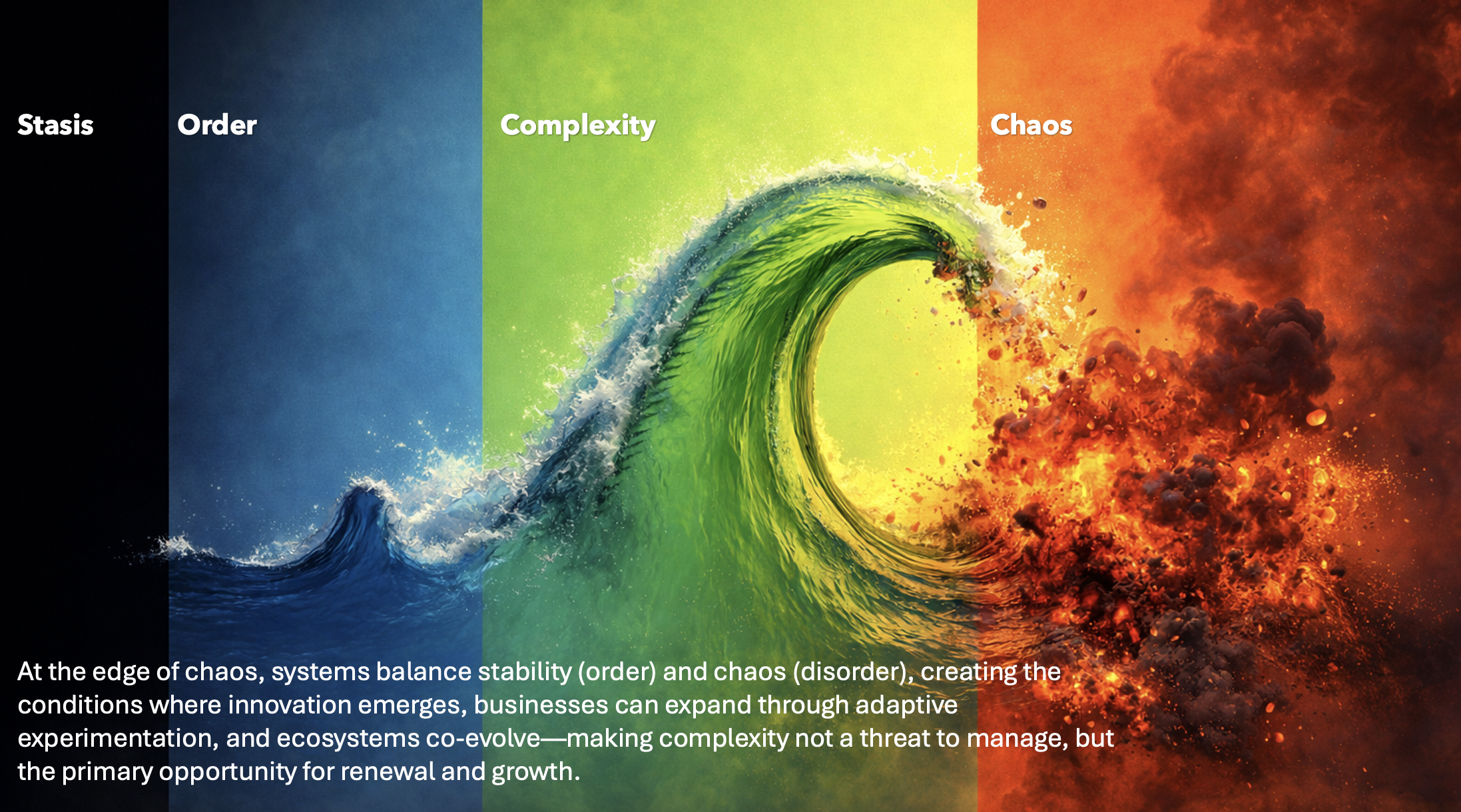
The optimal zone for such innovation is the Edge of Chaos, which is a critical transition state where a system balances order and stability with disorder and change. It is precisely in this zone, rather than in a state of total equilibrium, where optimal innovation occurs. For the modern enterprise, the Edge of Chaos is not a threat to be avoided, but a strategic space to be occupied and, if necessary, intentionally created. Competitive advantage in this regime is defined not by scale or static efficiency, but by architectural flexibility and the velocity of learning in response to constant internal and external feedback loops.
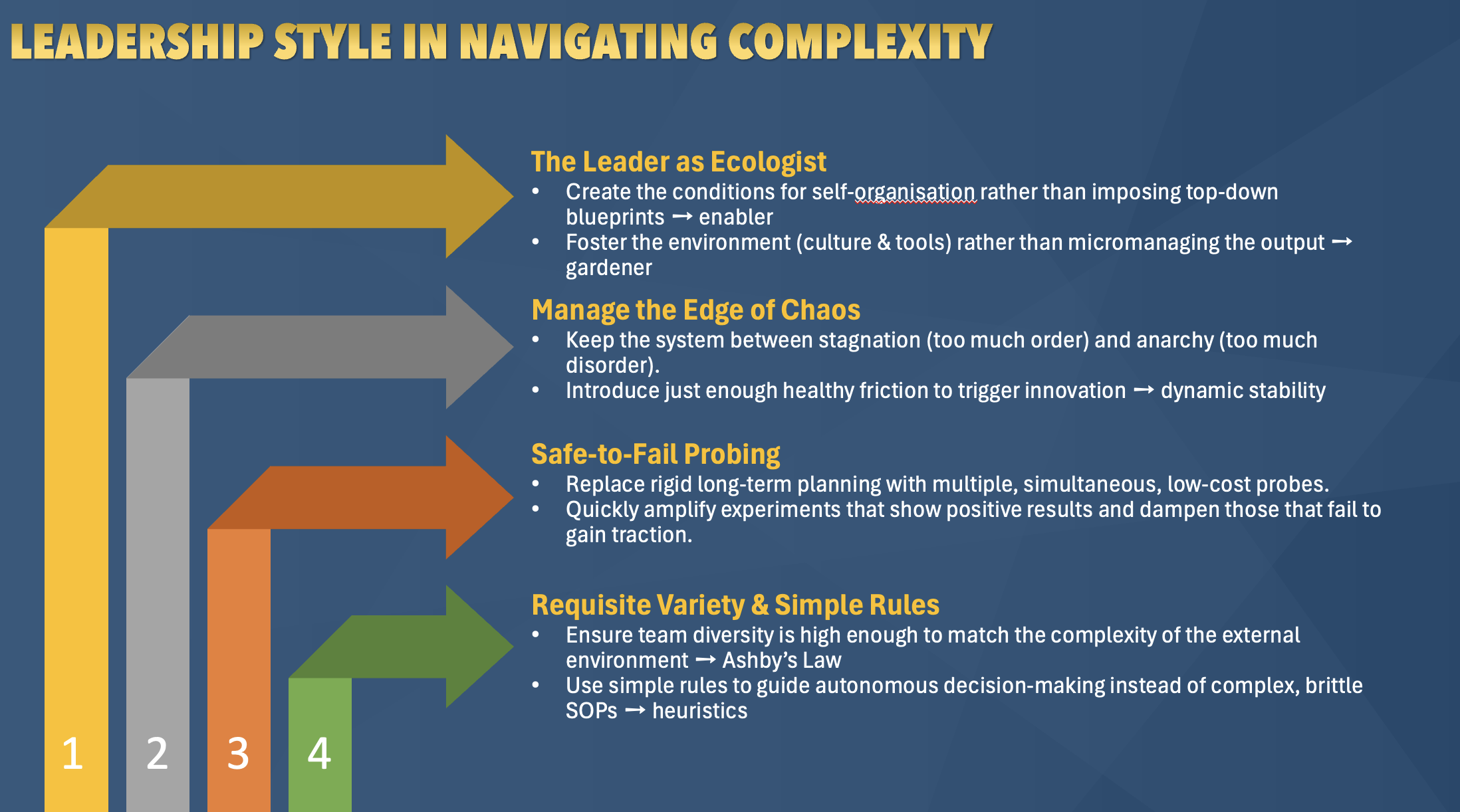
Leadership within this complex environment requires a fundamental shift in identity toward that of an ecologist. The leader’s primary duty is no longer the top-down control of outputs, but the creation of conditions and cultures that enable teams to self-organise. This involves managing the delicate tension at the Edge of Chaos, introducing enough healthy friction to trigger innovation without descending into systemic anarchy. Rigid & brittle SOPs are replaced by simple rules or heuristics that guide autonomous decision-making amidst ambiguity. Leaders must facilitate safe-to-fail probing, i.e. launching multiple, simultaneous, low-cost experiments to detect strategic signals and opportunities that traditional analytical models inevitably miss.
Strategic management in the exponential era demands ambidextrous design, balancing the exploitation of core operations with the continuous exploration of new ventures through modular structures. This necessitates the orchestration of resources far beyond traditional organisational boundaries, incorporating partners, start-ups, and regulators into platform-based strategies. Strategy is viewed as a process of co-evolution, where the organisation constantly reinvents itself to remain congruent with a shifting environment.
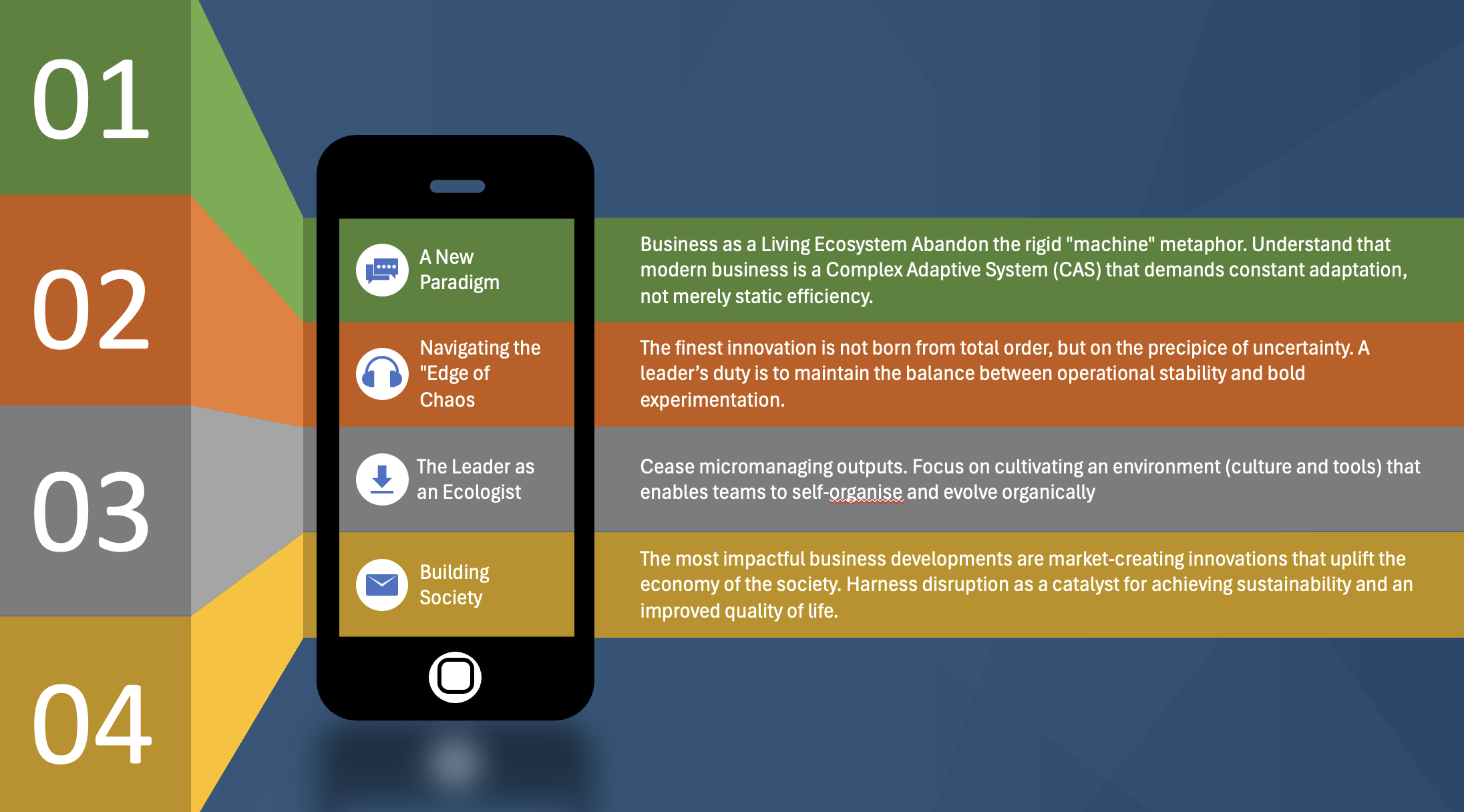
Finally, Management Accounting (MA) serves as the vital navigation instrument in this journey through the Strategic Planning for Exponential Era (SPX) framework. MA must evolve to support dynamic feasibility, utilising Real Options Analysis to value investments as strategic options—the right to expand, delay, or pivot—rather than rigid, one-way capital bets. This implementation includes Agile Capital Budgeting, where funds are allocated to strategic “buckets” rather than granular, unproven projects. By abandoning the stagnation of rigid annual budgets in favour of Rolling Forecasts and Throughput Accounting, MA ensures that resource allocation is driven by real-time feedback and the velocity of value conversion. Ultimately, the most profound business developments are market-creating innovations that not only ensure sustainability but actively uplift the economy and quality of life for society


MSME Financing

Now about the MSME ecosystem.

The Govt has repeatedly mentioned that we have 65 million MSMEs in Indonesia, and that the MSME are the very backbone of the national economy: they contribute ±61% of GDP and provide ±120 million jobs, nearly the entire labour force. Yet for all their importance, they are treated with something close to neglect by national financial system. While state banks happily court the large corporates and property developers, the millions of small firms that keep the country running receive less than 20% of their credit. And when the MSME secure a loan, they pay dearly for it, at interest rates of 12%–18% per year, even when BI’s rate rests at 5%. A curious kind of financial apartheid: the majority does the heavy lifting, the minority enjoys the cheap capital.

The Minister of Finance, to add insult to injury, has been swifter at taxing MSME than at financing them. Efforts to broaden the tax base focus on micro firms while the big players continue to enjoy exemptions, incentives, and creative loopholes. Programs intended to strengthen domestic small industry, remain piecemeal, minimally supported, and shifted instead to use the MSME data for taxing. The rhetoric is that MSMEs are the backbone of the economy; the practice is that they are milked like docile cows for easy revenue, without being fed the credit that might fatten them into global competitors.

There is surely the KUR program the Govt always mentions, which offers subsidised credit to small businesses. In H1/2025, around Rp 133T was disbursed to some 2.3 million borrowers. That number is impressive on its own, yet it reaches only 3% or 4% of the total MSME population. And the balance is skewed beyond recognition: nearly 1.9 million of those borrowers were micro firms, a modest 159 thousand were small firms, and a mere 16 thousand were so-called ultra-micro. Medium-sized enterprises are excluded entirely, with the optimistic expectation that they will graduate to commercial loans — a graduation ceremony that only rarely takes place.

KUR is not nothing, but neither is it enough. What Indonesia needs is a breakthrough: a national credit guarantee scheme that shares risks between the state and the banks and, in doing so, brings down lending rates while opening the doors of finance to millions who are currently shut out. The idea is simple. If a portion of loans in a defined portfolio go bad, the state-backed guarantor pays part of the loss. With that safety net in place, banks can lend at lower rates and to a wider circle of borrowers.

This is not some wild experiment. South Korea’s KODIT has long guaranteed up to 85% of SME loans; Japan’s municipal credit guarantee corporations have done the same for decades, usually at 80% coverage. The US Small Business Administration runs its own guarantees on 75% to 85% of small business loans. Europe operates portfolio schemes through InvestEU. The lesson is consistent: when governments shoulder part of the risk, banks lend more, charge less, and the fiscal costs remain entirely manageable.

What would this look like in Indonesia? Imagine a scheme supporting 1.5 million loans per year, with an average size of Rp 150 million, creating an annual portfolio of roughly Rp 225T. The guarantor would cover 40% of first losses, capped at 10% of the portfolio to prevent excess. Banks would pay a fee of 1.8% p.a., softened by a small state subsidy of 0.4%. In practice, this would mean loans to small businesses priced at about 3.5% lower than they are today. The expected fiscal cost to the state would be about Rp 2.3T per year, with a guarantor capital buffer of roughly Rp 8T. For the price of a single prestige infrastructure project, the government could transform access to finance for millions of enterprises.

The institutions are already there. Jamkrindo and Askrindo could act as front-line guarantors just like KUR. PII could serve as a backstop. Multilateral lenders such as the World Bank, ADB, or IsDB could add further insurance, while state and private banks would originate the loans. Oversight and enforcement would fall to the Ministry of Finance, Bank Indonesia, and the Financial Services Authority (OJK), with the Ministry of MSME ensuring that outreach truly extends beyond Java and into women-owned and first-time borrowers.

The expected results could be far from trivial. With 1.5 million new loans guaranteed each year, more small firms would cross into the formal economy. Average borrowing rates would fall from the current 12% to 15% into the single digits. Employment would grow by perhaps one million jobs a year, as enterprises invest and expand. GDP growth would tick upward by at least 0.5%. And because borrowers under the scheme must be formally registered, the tax base would widen, meaning the program could ultimately pay for itself.

Indonesia cannot hope to reach sustained 6%–7% growth while its entrepreneurs are trapped in a high-cost credit desert. This lending guarantee program would provide them with the rain they need. Alongside, the state should push forward with digital credit scoring, drawing on tax, e-commerce, and utility data; it should open the way for SME bonds and securitisation; and it should modernise collateral laws so that machinery, vehicles, and inventory can be pledged as security, not only land and buildings.

Without accelarating these programs, Indonesia risks remaining a dual economy: one world of corporates enjoying cheap capital and tax incentives, and another of millions of MSMEs left to carry the country on their backs while paying through the nose for the privilege.

PMO Kopi Nusantara

Melengkapi expertise yang memanjang dari jaringan broadband, platform dan infrastuktur digital, kompleksitas dan ekosistem ekonomi, hingga strategi bisnis berbasis ekosistem, dan seterusnya, aku akhirnya terjebur ke pengembangan bisnis berbasis ekosistem sosioekonomis, termasuk UMKM, pertanian, dll.

Untuk pertanian, tugas ini belum sampai satu bulan aku pegang, tapi telah membawaku menjumpai PMO Kopi Nusantara. Sebuah workshop diselenggarakan di Rancabali, di tengah perkebunan teh milik PTPN VIII, di tepi Situ Patengang. Cuaca sejuk menarik, dan menggoda untuk mengawali dengan segelas kopi lokal dari Bandung Selatan.

PMO Kopi Nusantara dibentuk Kementerian BUMN di awal 2022, beranggotakan BUMN, industri, asosiasi, dan lembaga penelitian berkait pengembangan agriculture kopi nasional. Selain berisi pembinaan atas petani kopi, PMO juga menjalin sinergi antara industri dan petani, serta memperbaiki rantai pasok kopi nasional. Telkom berperan dalam PMO ini melalui pemanfaatan platform Agree. Piloting PMO diselenggarakan di empat provinsi, yaitu Lampung, Jawa Timur, Jawa Barat, dan Sumatera Utara.

Industri kopi merupakan industri yang sangat penting bagi Indonesia, baik dari segi ekonomi maupun budaya. Indonesia dikenal sebagai produsen kopi terbesar keempat di dunia, dengan produksi kopi mencapai sekitar 650 kiloton per tahun. Kontribusi industri kopi terhadap perekonomian Indonesia mencapai ±1.25% total PDB.

Kopi juga merupakan salah satu komoditas ekspor utama Indonesia. Ekspor kopi Indonesia mencapai ±400 kiloton per tahun, dengan nilai ±US$ 1.1 miliar.

Kopi memiliki nilai penting bagi Indonesia dari segi ekonomi maupun budaya. Pengembangannya harus dilaksanakan secara sinergistik dengan memanfaatkan strategi berbasis ekosistem yang memberikan value maksimal, terutama untuk para petani kopi.