
Strategi Pengembangan Ekosistem

Tulisan di Complexity Center tentang Padi UMKM sebagai case sebuah strategi bisnis berbasis complexity mengundang beberapa rekan mengajukan pertanyaan menarik, khususnya dalam bridging dari perspektif tentang complexity yang dianggap sangat teoretis dan rumit ke implementasi real di dunia bisnis dan teknis. Kebetulan aku sedang tulis paper berkait hal itu, yang fokusnya bukan ke produknya, tetapi ke strategi perusahan dalam mengembangkan ekosistem: bagaimana ekosistem ini dikawal, oleh siapa, dan dengan modal apa.

Saat pengembangan awal Padi UMKM di tahun 2020 (masa awal pandemi Covid-19), pengembangan ekosistem bisnis di Telkom Group dipimpin oleh Subdit Sinergi, bagian dari Dit Strategic Portfolio (DitSP). Platform dan bisnis Padi UMKM sendiri dipegang oleh Divisi Digital Business & Technology (DBT), bagian dari Dit Digital Business (DitDB). Ini bukan redundancy atau kesalahan rencana koordinasi, melainkan desain yang dibuat saat DitDSP dipecah jadi DitSP dan DitDB. Dalam case Padi UMKM, Div DBT berfokus pada platform, produk, dan bisnis; termasuk pembangunan, pemeliharaan, pengembangan, dan ekspansi. Kualitas, kapasitas, experience, inovasi, dll dll. Subdit Sinergi bekerja di lapisan lain: membentuk dan menumbuhkan ekosistem.
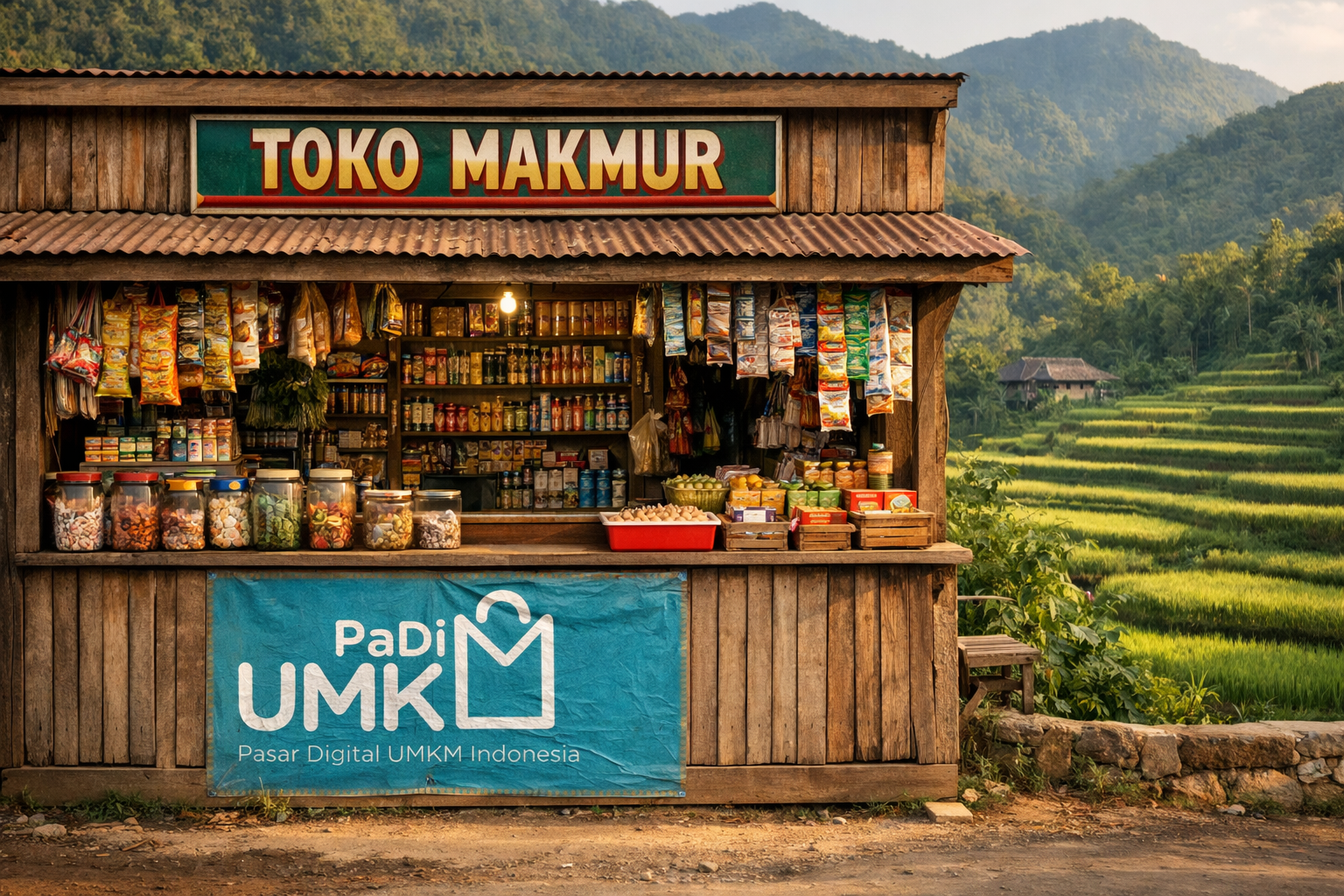
Sepenting apa strategi ekosistem? Padi UMKM bukan marketplace. Telkom baru membunuh marketplace Blanja.com saat Padi UMKM dirancang. Platform baru ini dirancang sebagai arsitektur koordinasi, tempat BUMN yang memiliki operasi pengadaan, UMKM di berbagai tingkatan dan sektor, lembaga keuangan, komunitas pembina UMKM, kementerian, dan lembaga regulasi dapat berinteraksi di level policy, strategi, bisnis, dan teknis. Setiap agent yang berbeda ini tentu memiliki concern yang sangat berbeda. Perspektif Complexity Economics dari WB Arthur menunjukkan bahwa dalam sistem seperti ini para agen beroperasi dalam ketidakpastian fundamental: mereka tidak memiliki rasionalitas seperti yang dibayangkan dalam perspektif ekonomi klasik; melainkan bersifat adaptif dan tunduk pada irasionalitas kolektif, volatilitas, dan disrupsi yang tidak dapat diprediksi dari perilaku setiap agent. Nilai keseluruhan sistem (synergy value) merupakan emergence yang muncul dari interaksi dinamis antar agent, bukan dari value setiap agent, termasuk agent kunci seperti pemilik platform. Para BUMN yang dikoordinasikan oleh Kementerian BUMN secara kolektif diposisikan sebagai pemilik simbolik ekosistem ini. Platform dimiliki Telkom, tetapi ekosistemnya dimiliki bersama. Apa inovasi yang diciptakan dari kebersamaan ini? Saat pandemi Covid-19 baru melanda, aku baca buku Christensen tentang Prosperity Paradox: pertumbuhan bisnis yang sesungguhnya, yaitu market-creating innovation, bukanlah soal mendatangi dan mengembangkan pasar yang ada, melainkan justru dari menciptakan pasar baru dari nonconsumption, dalam hal ini dari jutaan UMKM yang sebelumnya aksesnya sangat lemah ke industri nasional termasuk BUMN. Dalam bahasa HBR: strategi follow the money itu kuno dan bodoh, dan harus digantikan oleh follow where the money goes, atau create the environment where the money will have to go. Kembali ke Christensen, ini yang disebutnya paradoks kemakmuran: keberpihakan pada ekonomi rakyat adalah strategi bisnis yang paling efektif.

Di Telkom, Subdit Sinergi menjalankan tugas ini nyaris tanpa otoritas pada unit produksi dan unit bisnis, tanpa team dan anggaran yang besar, dan tanpa kendali internal atau eksternal. Modalnya adalah tuntutan visi dan strategi perusahaan, kepemimpinan yang suportif, keterlibatan yang dalam dan detail dalam lanskap kelembagaan, dan kemampuan membangun jejaring lintas unit dan institusi, melalui pengembangan konteks, komunikasi dan negosiasi, hingga approach pada regulasi. Dalam praktiknya, kami mengkoordinasikan para BUMN, termasuk via PMO Padi dan via kepemimpinan KBUMN, untuk mengkonversi operasi procurement menjadi demand engine; bernegosiasi dan berkolaborasi di level policy, strategy, hingga event dalam kerangka BBI (Bangga Buatan Indonesia), PBJP (Pengadaan Barang/Jasa Pemerintah), dan P3DN (Peningkatan Penggunaan Produk Dalam Negeri) yang saat itu dipimpin Kemkomarves bersama K/L/PD terkait; mengawal koordinasi program ekspor bersama berbagai kementerian untuk mendorong UMKM menembus pasar internasional; membangun dan merawat hubungan dengan komunitas pengembang UMKM, termasuk Pemprov, Pemkab, ormas, dan marketplace, agar suplai UMKM berkualitas terus mengalir; serta menstrukturkan kesepakatan dengan bank dan lembaga keuangan seperti BRI Group (termasuk Pegadaian, PNM, Bank Raya) untuk memastikan UMKM punya akses pembiayaan yang akan memperbesar volume pasar. Ini tidak bisa menggunakan akses komando, melainkan melalui yang dalam istilah CAS disebut interaction architecture: membangun konteks di mana para agent terdorong untuk berkoordinasi secara sukarela demi kepentingan masing-masing.

Karena hal-hal ini merupakan implementasi dari complexity, banyak hal yang tampak kontraintuitif saat dilihat dari perspektif manajemen konvensional. Walau memiliki produk, platform, dan brand Padi UMKM, Telkom tidak mengklaim kepemilikan ekosistem. Padi UMKM diposisikan dalam narasi kepentingan nasional, bukan narasi korporat. Saat pemerintah pusat, dalam forum BBI/P3DN/PBJP meminta Padi UMKM diekspansi ke seluruh K/L/PD, Telkom mengusulkan agar pengadaan K/L/PD tetap dipegang entitas pemerintah, yaitu LKPP, dengan Telkom berlaku sebagai pengembang platform yang merupakan ekspansi dari Padi UMKM. Ini adalah ecological thinking: menjaga keberagaman dan modularitas agar sistem tetap adaptif, tidak terjebak dalam rigidity trap, di mana konektivitas yang terlalu tinggi tanpa keberagaman yang cukup membuat sistem justru menjadi rapuh. Telkom juga membangun path dependence: titik di mana ekosistem dapat tertanam dalam di berbagai lapisan institusional sehingga tak mudah dihentikan, kecuali oleh perubahan struktur yang massive oleh seluruh stakeholder. Ini adalah desain yang matang untuk keberlanjutan sistemik: memanfaatkan mekanisme increasing returns yang Arthur gambarkan, di mana setiap BUMN baru yang bergabung meningkatkan nilai platform bagi UMKM, dan setiap UMKM yang sukses bertransaksi memperkuat legitimasi politik ekosistem secara keseluruhan. Hasilnya terlihat nyata: per akhir 2024, ratusan ribu UMKM B2B terdaftar, 74.000 pembeli B2B, hampir 300.000 transaksi dalam setahun, dan GMV kumulatif melampaui IDR 28 triliun sejak peluncuran.

Dari sisi manajemen strategis, aku coba formulasikan narasi ini dalam paper Ecosystem Stewardship as Organisational Capability (masih ditulis). Hal yang dilaksanakan oleh Subdit Sinergi dalam kerangka Padi UMKM adalah sebuah kapabilitas organisasional yang nyata dan unik. Strategi di level ekosistem belum secara serius masuk ke dokumen strategi para BUMN. Ecosystem stewardship ini bukan platform management, bukan stakeholder management, dan bukan sekedar synergy program; melainkan sebuah kapabilitas untuk mengkatalisasi, mendukung, dan mengadaptasi sistem multi-aktor lintas batas kelembagaan, dimana para agent memiliki interdependensi dalam bentuk otoritas penuh untuk mengarahkan sistem secara sepihak. Tentunya cukup banyak narasi akademis yang mengimplementasikan CAS pada transformasi organisasi, supply chain, kesehatan, dan lain-lain. Namun bahkan belum banyak ditemukan narasi berisi formulasi eksplisit dan kohesif yang menyatukan complexity economics (Arthur), teori CAS (Holland), market ecology, dan kerangka ekosistem digital, lalu menerjemahkannya ke dalam desain dan implementasi kapabilitas organisasional lintas-institusi dalam skala nasional; dan kemudian bukan saja dijadikan kerangka teoretis, melainkan benar diimplementasikan dan menghasilkan dampak ekonomi yang terukur. Dalam pengertian itulah Padi UMKM, dan ecosystem stewardship sebagai kapabilitas yang menopangnya, menjadi inovasi yang layak mendapat perhatian lebih dari sekadar kisah sukses digital.

Ekosistem dalam konteks ini juga tidak selalu merujuk pada hubungan dengan pihak eksternal. Untuk perusahaan dengan grup yang besar, seperti holding, afiliasi, dan anak perusahaan, termasuk seperti Telkom Group, kita meyakini bahwa koordinasi dan kolaborasi yang paling efektif justru lahir ketika kita mengadopsi perspektif kompleksitas dan memperlakukan hubungan dalam grup sebagai ekosistem itu sendiri. Entitas-entitas dalam grup yang berbeda bukan sekadar unit yang perlu disinergikan secara administratif, tetapi dipandang sebagai agen-agen heterogen dengan visi misi, kapabilitas, dan dinamika adaptasi yang beragam. Mengelola mereka dengan prinsip ecosystem stewardship, bukan dengan pendekatan top-down yang mekanistik, adalah cara yang jauh lebih tepat untuk menciptakan nilai bersama. Dalam dunia yang semakin kompleks dan volatile, kemampuan semacam ini bukan kekenesan intelektual, melainkan telah menjadi prasyarat untuk bertahan dan tumbuh.

Padi UMKM — A Complexity Case

When I first designed what later became Padi UMKM, I did not do it in a boardroom. I did it at home, during long months of WFH in the middle of the Covid-19 pandemic. I drew the system on papers spread on the floor. At that time, my head was full of ideas about ecosystems, complexity theory, and complexity economics. I was not thinking about building another digital platform. I was thinking about how economic coordination itself breaks down under systemic shock, and how new coordination patterns might emerge when old ones collapse. In that sense, Padi UMKM was born less from a product mindset than from an ecosystem mindset, with complexity theory consciously in the background.

When the pandemic hit, what collapsed was not only the economy. What collapsed was the coordination logic of the economy. Supply chains broke, demand evaporated, SMEs lost access to markets, and institutions discovered that their standard operating procedures were designed for stability, not for systemic disruption. Many organisations reacted by accelerating digital projects, launching platforms, and optimising internal processes. That helped, but it did not address the deeper problem. The economic ecosystem itself had lost its organising structure. Actors that were rational in isolation could no longer produce coherent outcomes collectively. This is how complex systems behave under stress: when established coordination patterns fail, local rationality no longer aggregates into systemic order.

Padi UMKM did not start as a brilliant digital product idea. It started as a response to a coordination failure across a fragmented system of SOEs, SMEs, banks, regulators, ministries, and development agencies. All were acting with good intentions, yet through incompatible logics, timelines, and mandates. The system was not short of initiatives; it was short of coherence. In complexity terms, the economy had been pushed far from equilibrium, and the challenge was not optimisation but reorganisation. What was needed was not another tool, but a new pattern of interaction among heterogeneous agents.

The real innovation of Padi UMKM was therefore not the platform. The platform was the easy part. The digital workforce of Telkom Group can design platforms; that is an operational capability. The platform was necessary, and it became the core infrastructure of the ecosystem, but it was not the breakthrough. The breakthrough was the deliberate redefinition of roles within the economic system. SOEs must reposition their procurement operation into a capability of creating new market, i.e. an SME-based market structure. SMEs were not framed as beneficiaries of aid, but as economic agents that could be structurally integrated into formal procurement and value creation. Banks and financial institutions were not treated merely as lenders, but as part of an enabling architecture that combined financing with capability development and pathways to export. What changed was not a feature set. What changed was the pattern of interaction between economic actors.

The formal launching of Padi UMKM itself was not initiated by Telkom or by the Ministry of SOEs. It was planned within the nationwide BBI (Bangga Buatan Indonesia) program, because the central government needed a real, executable instrument to accelerate domestic economic circulation under crisis. Telkom showed a commitment to develop the platform, even though it was still imperfect at that time. The urgency was national, not corporate. This matters, because it positioned Padi UMKM from the beginning not as a corporate product launch, but as a systemic intervention embedded in a national recovery narrative. The early external promotion of Padi UMKM, beyond the internal SOE environment, was also driven by the BBI program. Over time, almost by systemic selection rather than by design, Padi UMKM became the de facto e-commerce infrastructure for BBI, as other platforms could not fit the specific institutional and ecosystemic roles required by the program.

From the beginning, we made a counterintuitive choice in the way the system was governed. Telkom deliberately limited its role to being the product and platform owner. The ecosystem itself was not branded as Telkom’s program. The community was symbolically owned by the Ministry of SOEs and by SOEs collectively. Even the name Padi UMKM did not originate from Telkom. This was not a political compromise; it was a strategic design choice grounded in complexity thinking. In complex systems, ecosystems tend to collapse when one actor over-claims ownership. When the platform owner also claims to own the ecosystem, other actors reduce their commitment, hedge their participation, or quietly resist. By stepping back from symbolic ownership, Telkom created space for other institutions to step forward. The platform provided the infrastructure, but the legitimacy of the ecosystem was deliberately distributed across actors.

At some point, something structurally interesting happened. The initiative crossed a threshold where no single actor could kill it anymore. The CEO of Telkom could not simply shut it down because the ecosystem had become institutionally embedded beyond Telkom. The Minister of SOEs could not dismantle it easily because it had become part of the official narrative of national economic recovery. The President could not disown it because it had been publicly positioned as a success story through BBI, PEN, and related programs. This was not political theatre. This was the moment when the system acquired path dependence. Once an initiative becomes embedded across multiple layers of institutional narrative and governance, it ceases to be a project and becomes part of the system itself. At that point, you are no longer managing a prograe. You are dealing with a living economic structure.

Value in Padi UMKM did not come from transactions alone. It emerged from the coupling of multiple layers of interaction. Transactions between SOEs and SMEs were reinforced by access to credit, by certification mechanisms that enabled formal participation, by development programmes that upgraded SME capabilities, and by pathways to export markets. None of these elements, on their own, would have been transformative. The transformation emerged from their interaction. This is how complex economies create value: not through linear pipelines, but through ecosystems in which different forms of capital, i.e. financial, institutional, social, and operational, reinforce one another over time.

Internally in Telkom, there was a structural separation of roles that proved critical. The Digital Business Directorate (DDB) operated at the product and business level. Its logic was operational: build, run, scale, monetise, and maintain the platform. Even as the platform owner and economic keystone, it remained only one agent within the broader ecosystem. In parallel, the Synergy Subdirectorate under the Strategic Portfolio Directorate worked at the ecosystem level. This role was not about features, roadmaps, or KPIs. It was about sensing emergent patterns of collaboration, mediating conflicts between institutions, and navigating collisions between policy signals and organisational incentives. In the early phase, the Synergy team also played a foundational role in organising cross-SOE agreements, preparing the multi-actor launch, embedding Padi UMKM within the BBI program, and connecting it with multiple SME build-up initiatives involving the Ministry of SMEs, the Ministry of Trade, and other institutions. This work was not linear project management; it was ecosystem orchestration under uncertainty.

In Indonesia’s context, the interaction between SOEs, SMEs, banks, and regulators is not merely complex; it is quasi-chaotic. Mandates overlap, incentives conflict, and policies evolve at different speeds and under different political pressures. In such an environment, precise prediction is an illusion. What becomes possible instead is navigation: sensing where constructive patterns of emergence are forming, dampening destructive feedback loops before they escalate, and shaping the boundaries within which the ecosystem evolves. This is not classical management. This is leadership under complexity.

As a result of its early success, there was a moment when the government, again through the BBI programme, asked to expand Padi UMKM to cover all government agencies (K/L/PD). On paper, this looked like success, with an enormous projected GMV. In reality, it carried a systemic risk. Full integration into the broader government procurement apparatus would have imposed rigid compliance structures and administrative constraints that could have frozen the adaptive dynamics that made the ecosystem work. The decision to return that expansion to LKPP, while positioning Telkom only as a platform provider for LKPP, was a deliberate choice to preserve modularity and flexibility over symbolic scale. In complex systems, scale without adaptability is not growth; it is fragility disguised as success.

What this experience ultimately taught us is uncomfortable for traditional management thinking. In complex economic ecosystems, you cannot engineer outcomes. You can only design conditions: boundaries, incentives, roles, and narratives that make constructive emergence more likely than destructive collapse. The platform mattered. The technology mattered. But what mattered more was the humility to accept that once an ecosystem becomes alive, you are no longer the architect standing outside the system. You are one of the agents operating within it.

The strategic lesson for C-level leadership is this. In times of systemic disruption, competitive advantage no longer lies primarily in having the most sophisticated product or the fastest execution. It lies in the capability to shape interaction spaces across institutions, sectors, and policy domains. Leadership shifts from control to stewardship. Strategy shifts from optimisation to navigation. And success is no longer measured only by ownership, but by whether the system you helped catalyse can survive, adapt, and continue to create value even when you step back.

That, ultimately, is what Padi UMKM represents. Not a digital product success story, but a case of how leadership, strategy, and technology can be recomposed to operate effectively in a complex, adaptive economy under crisis. It is an ecosystem in motion. It is Synergy in action.

Synergy Value as Emergence

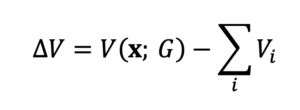
When considering mergers, acquisitions, alliances, or even intra-group synergies, it is useful to shift our perspective away from additive arithmetic and towards the philosophy of emergence. In complex systems, including business ecosystems as complex adaptive systems, value does not reside solely within the parts; rather, it arises through the patterned interactions between them. This emergent phenomenon is precisely what in corporate finance is labelled synergy value. In formal terms, we may describe the total incremental value of a collaboration as

where V(x; G) denotes the value of the whole system, generated by the vector of resources and activities x under a specific governance structure G, and ∑V represents the value of each entity in isolation. The very fact that ΔV may be greater than zero testifies to emergence: complementarities in action, dependencies properly orchestrated, and adaptive patterns unfolding across the system.

The Levers of Emergent Synergy

Four principal levers determine whether emergent value materialises or evaporates. The first is complementarity, or what economists term supermodularity. This describes the situation in which activities reinforce each other such that the marginal return of undertaking one activity is enhanced by the undertaking of another; formally, the cross-partial derivatives are positive (𝛿²V/𝛿xi 𝛿xj > 0). It is here that the popular slogan “one plus one equals more than two” has rigorous grounding.

The second lever is the interdependence structure. Every collaboration has a topology of dependencies, where some assets act as complements, others as substitutes, and some nodes become bottlenecks through which the value of the entire system is channelled. In business ecosystems, mapping this structure is indispensable, for it often dictates whether modularity and flexible linkages suffice, or whether full absorption is required.

The third lever is defined by the adaptive rules of the system. A collaboration is not static; it is a complex adaptive system in which local decisions, feedback loops, and routines create new global patterns. Where local experimentation is permitted, and where feedback loops are properly designed, valuable behaviours diffuse through the organisation or alliance. Where rigidity prevails, the system is condemned to stasis, and synergy remains a theoretical promise rather than an emergent reality.

Finally, there is the matter of orchestration capacity. This refers to the dynamic capabilities of leadership—sensing opportunities, seizing them through resource allocation, and reconfiguring the system as environments change. Ashby’s principle of requisite variety reminds us that the variety of governance and decision-making tools must match the variety and volatility of the environment. Without adequate orchestration, even strong complementarities and favourable topologies may collapse under the weight of integration costs.

Applications Across Collaboration Types

In mergers and acquisitions, the choice of integration model should mirror the degree of interdependence. The celebrated Haspeslagh–Jemison framework reminds us that absorption is not always optimal; linkage or preservation may unlock more emergent value when autonomy is vital. The risk of the so-called synergy mirage lies precisely in misjudging complementarities and ignoring the time it takes for emergent patterns to stabilise. Thus, every acquisition is less a completed transaction than a hypothesis about the future, whose proof lies in the integration process.

In alliances and joint ventures, synergy takes the form of options on emergence. Here, limited commitments allow parties to test complementarities without over-committing capital. The collaborative form is well-suited to contexts of uncertainty, where exploration of emergent patterns is required. Ecosystem logic also applies: co-opetition and the management of network externalities often define the extent of emergent value.

For intra-group business synergy, emergence must be cultivated across corporate units. Here, Herbert Simon’s notion of near-decomposability becomes instructive: groups should design modular interfaces so that subsidiaries adapt locally yet align globally. To maintain cooperation, emergent rents must be shared fairly; cooperative game theory suggests the Shapley value as one method of allocating incremental value in proportion to each unit’s marginal contribution. Without such fairness, group members are tempted to defect, undermining the collaborative potential of the system.

Measuring and Governing Emergence

Because synergy is emergent, it resists simple enumeration. Yet it is not beyond the reach of disciplined measurement. One may begin with a complementarity map, estimating where cross-partials are most positive, and therefore where joint action may yield the greatest return. Alongside, an ecosystem dependency graph may be drawn, in the spirit of Ron Adner’s ecosystem mapping, to reveal missing complements and bottlenecks whose removal could unlock value.

Where uncertainty is high, the logic of real options should prevail. Pilot projects, staged investments, or minority stakes serve as options to explore emergent potential without risking catastrophic downside. Parallel to this, a system of synergy accounting may be implemented, in which incremental value is decomposed using Shapley allocations, thereby aligning incentives with marginal contributions to the whole.

The Philosophical Bottom Line

Synergy lives not in assets but in interactions. Corporate actions—whether a merger, an alliance, or an intra-group initiative—are best understood as interventions in a complex system. When complementarities are strong, interdependencies are designed with care, adaptive rules permit experimentation, and orchestration capacity is sufficient, emergent synergy is more than a hopeful metaphor; it becomes an observable reality. Conversely, where these levers are mismanaged, the promised “1 + 1 > 2” dissolves into disappointment, integration costs, and value destruction.

Thus, the philosophy of emergence, long a staple of complexity science, is not an academic curiosity but a practical guide to business collaboration. It teaches us that the true measure of a deal or alliance lies not in the parts themselves, but in the patterns of interaction that the collaboration enables.