Storytelling

Penceritaan, narasi, atau storytelling merupakan cara alami dan mendasar untuk memahami dan menjelaskan dunia. Sebagai model acuan mental, cerita membentuk struktur dasar bagaimana manusia menyusun, mengaitkan, dan mengingat informasi. Dalam setiap cerita, terdapat alur, tokoh, dan konteks yang memberikan kerangka terstruktur, memungkinkan otak manusia mengolah informasi kompleks menjadi pola yang lebih mudah dipahami. Cerita mampu mentransformasikan ide-ide abstrak menjadi sesuatu yang konkret, menciptakan hubungan emosional dan kognitif antara pendengar atau pembaca dengan gagasan yang disampaikan.

Dalam masyarakat, cerita berfungsi sebagai media utama untuk menyampaikan wawasan budaya, tradisi, dan nilai-nilai. Sebagai sarana kolektif, cerita membantu menjaga kesinambungan identitas budaya, mengajarkan norma-norma sosial, dan memperkuat rasa kebersamaan. Wawasan budaya yang tersampaikan melalui cerita tidak hanya memperkaya pemahaman individu tetapi juga memperkuat ikatan dalam komunitas, menciptakan kesadaran kolektif yang lebih mendalam.

Di tingkat personal, cerita memiliki hubungan langsung dengan model mental seseorang. Manusia lebih mudah mengingat dan memahami konsep ketika informasi disajikan dalam bentuk narasi yang terstruktur. Keterkaitan logis dan emosional dalam cerita memungkinkan individu memproses kondisi rumit dengan lebih baik. Ketika elemen-elemen cerita dipadukan dengan emosi, gambar mental, dan konteks relevan, ini membantu membentuk konsep yang lebih kokoh dalam memori jangka panjang.

Cerita dimanfaatkan secara luas dalam berbagai bidang untuk mencapai tujuan tertentu. Dalam komunitas, cerita digunakan untuk menyebarkan pengetahuan secara efektif, baik dalam bentuk tradisional seperti folklore maupun melalui media modern. Di ranah intelektual, cerita menjadi alat untuk menghimpun dan melembagakan pengetahuan sebagai bagian dari intellectual capital (IC). Dengan menstrukturkan pengetahuan dalam bentuk narasi, cerita membantu organisasi atau komunitas menciptakan aset pengetahuan yang dapat diwariskan dan diakses lintas generasi. Dalam pendidikan, cerita memainkan peran penting dalam meningkatkan efektivitas pembelajaran. Melalui cerita, siswa dapat lebih mudah memahami materi pelajaran, mengaitkannya dengan pengalaman pribadi, dan membangun pemahaman yang lebih mendalam.

Menariknya, cerita tidak selalu harus diingat dalam detailnya. Dalam banyak kasus, elemen kunci dari cerita, yang terekam sebagai priming memory, dapat memicu akses ke memori sadar di saat-saat tertentu. Misalnya, sebuah cerita tentang keberanian dapat memunculkan pola pemikiran atau tindakan tertentu saat seseorang menghadapi situasi sulit. Dengan demikian, cerita tidak hanya berfungsi sebagai media pengajaran tetapi juga sebagai pemandu bawah sadar yang membentuk cara seseorang bertindak dan bereaksi dalam kehidupan sehari-hari.
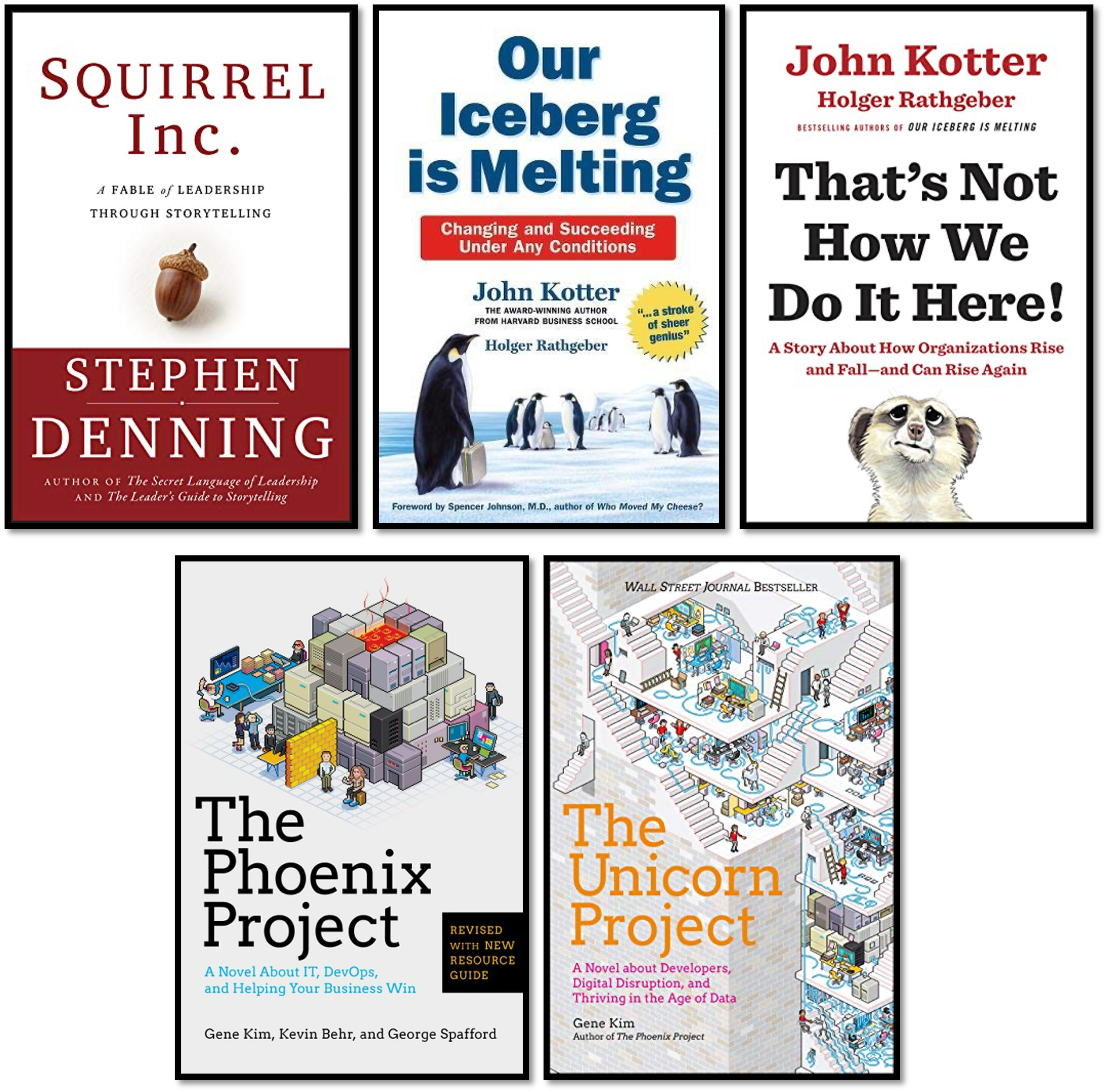

Beberapa buku yang menggunakan pendekatan storytelling untuk menyampaikan wawasan mendalam antara lain:

Bahkan, kitab suci tidak disusun dalam bentuk pasal-pasal, melainkan melalui rangkaian cerita yang sarat makna, yang mampu memotivasi dan membimbing manusia. Perubahan dalam masyarakat lebih mungkin terjadi melalui wacana yang disampaikan dalam bentuk cerita, narasi historis, dan simbol-simbol, daripada melalui proposisi logis semata.

Sartre, Foucault, Derrida on Zionism

The question of how the French philosophers regarded the issue of Palestine and zionists is often a source of disillusionment. Sartre, Foucault, and Derrida, three figures hailed for their intellectual audacity, revealed positions that were anything but uniform, and at times disappointing. All three carried the burden of European history: holocaust, antisemitism, colonialism; yet each worked through that burden in different and contradictory ways sometimes.

Sartre used to be the icon of anti-colonialism, fierce in his denunciation of France’s role in Algeria and outspoken against the Vietnam War, but paralysed when confronted with the issue of Palestine. In 1967, Les Temps Modernes, under his direction, published a major dossier on the Arab–Israeli conflict. Although he included Maxime Rodinson’s essay describing Israel as a “fait colonial”, Sartre’s own introduction insisted on foregrounding Jewish suffering in the wake of the holocaust. Palestinian political rights were acknowledged only obliquely. When Sartre and Beauvoir travelled to Cairo and Jerusalem that same year, Sartre’s reputation in the Arab world collapsed overnight.

In his final years, weakened by illness and reliant on others to record his words, Sartre, under Benny Lévy’s influence, spoke of jewish messianism. Beauvoir, outraged, dismissed these remarks as inconsistent with his lifelong values, denouncing them in La Cérémonie des Adieux as nothing more than hypocrisy: “Il ne croyait pas en Dieu. Il s’était laissé aller à employer ce mot: hypocrite.” A few years later, he accepted an honorary doctorate from the Hebrew University, a gesture impossible to read as anything but political. And when Edward Said finally met Sartre in 1979, he left bitterly disappointed: Sartre would speak only of “terror and repression on both sides”, refusing to affirm the Palestinians as a people with the right to nationhood. His universalism, so celebrated elsewhere, faltered here, caught in the gravity of the Shoah and aligned with the liberal zionism of the 1960s and 1970s.

Foucault presents a different face: the eloquence of silence. He wrote virtually nothing on Palestine issue. His political focus was elsewhere: on Iran, sexuality, prisons, and the disciplinary machinery of the modern state. Yet his silence still spoke. During 1967–68, while teaching in Tunis, he witnessed anti-zionism riots charged with antisemitism. The experience left its mark and perhaps explains his caution. But when he sat at the same table with Sartre and Said in 1979, he simply refused to speak on the Middle East. Said read this silence as tacit sympathy with Israel. Within the contours of Foucault’s thought, his refusal of “grand narratives” was consistent. Yet the irony is brutal: in a context where silence translates into complicity, his reluctance appeared as consent to the status quo.

Derrida followed another trajectory altogether. As a jew from Algeria, he was acutely sensitive to antisemitism, his closeness to Emmanuel Levinas reinforcing that sensibility. But he did not blind himself to Palestine. On visiting Jerusalem in 1988, Derrida spoke openly of Palestinian self-determination as an ethical imperative. In 1998, he went further, denouncing the occupation, calling for zionists withdrawal, while still affirming their right to security. By the early 2000s, he was even questioning the two-state solution itself, offering instead an alternative horizon inspired by South Africa: a post-apartheid democracy, rejecting ethnic hierarchy and embracing plurality. With the consistency of his deconstruction, Derrida dismantled the false binary of “pro-zionist” versus “pro-Palestine” and demanded a political horizon that exceeded stale diplomatic formulas.

Placed side by side, their stances reveal both failure and hope. Sartre longed for universality, yet remained entrapped by Europe’s own history, incapable of naming Palestinian nationhood, neglecting the obvious crimes of the zionism movement. Foucault retreated into ambiguity, refusing to be ensnared by grand narratives, but thereby appearing to condone injustice. Derrida, by contrast, pushed beyond binaries, opening a radical horizon that demanded justice for both. Said, who was bitterly disappointed by Sartre, found greater resonance with Derrida: both were critics of European humanism, both attentive to the Other, and both unwilling to endorse exclusivist identity politics.

Today, as the Palestinian tragedy deepens, the legacy of these philosophers still hangs unresolved. Sartre reminds us that even an ex anti-colonial icon may falter when shackled by his own trauma. Foucault reminds us that silence too is political, leaving traces of its own. Derrida, without offering a ready-made map, shows the courage of imagination: to conceive of a future beyond ethnic exclusivism, where justice is shared. Their divergent positions remain a mirror: do we dare to look with clarity, or do we continue to hide behind our histories?

Architecting Digital Transformation

I got this books a couple years ago: Architecting the Digital Transformation, edited by Zimmermann, Schmidt, and Jain. DOI: 10.1007/978-3-030-49640-1. It is interesting to find insights on digital transformation at an enterprise scale with emphasis on architecture-driven agility, the evolution of enterprise architecture roles, and the systemic cultural and organisational shifts necessary to support sustainable, adaptive transformation. Digital transformation has emerged as a critical undertaking for large organisations striving to remain competitive amidst rapid technological and societal change. Success at enterprise scale requires more than the adoption of new technologies — it demands a reimagining of business architecture, organisational culture, and governance mechanisms.

This book offers a research-based perspective on navigating this complexity. A key concept introduced is perpetual evolution—a modular and flexible architectural model that enables continuous innovation. Systems are designed so that components can be independently upgraded or replaced, allowing quick integration of new technologies while avoiding the constraints of monolithic infrastructure.

Complementing this architectural agility is the bimodal IT strategy, which combines a stable core system with a more experimental, agile layer. This setup enables organisations to innovate rapidly without compromising operational stability, bridging legacy systems with modern digital initiatives.

A recurring theme is the alignment between agile teams and enterprise architects. These roles have traditionally been at odds—agile valuing speed and adaptability, while architecture focuses on structure and governance. However, case studies in the book show that collaboration between the two improves both solution integrity and delivery speed. Architects are repositioned not as distant planners, but as facilitators embedded within teams.

To reinforce architectural discipline without imposing rigid control, the authors introduce lightweight governance and social incentives. The Architecture Belt, for example, is a gamified ranking system that encourages adherence to architectural principles in a positive, participatory way. This proves especially effective in large-scale agile environments where consistency must coexist with autonomy.

Cultural change is equally vital. Organisations must build digital dexterity—a culture of fast learning, experimentation, and team autonomy. Successful transformation often comes from empowered cross-functional teams that are free to explore, prototype, and iterate. In this paradigm, enterprise architects become active contributors to the digital ecosystem, supporting communities, sharing knowledge, and offering hands-on technical guidance.

The book also examines the shift in Enterprise Architecture Management (EAM). Traditional, centralised models are no longer compatible with agile and DevOps practices. Instead, Agile EAM is iterative, collaborative, and closely integrated with delivery teams, enabling organisations to respond more effectively to technological and market changes.

Finally, the authors present Service-Dominant Design (SDD) as a practical framework for creating digital services through co-creation. Rather than building solutions in isolation, SDD emphasises contextual understanding, stakeholder collaboration, and iterative development—ensuring outcomes that are both technically sound and meaningfully relevant.

In essence, the role of enterprise architecture is being redefined. The most effective digital transformations are those where architects take a hands-on role in shaping platforms, facilitating cross-team collaboration, and ensuring coherence across the digital ecosystem. By embracing both structure and agility, architecture becomes a living framework that evolves in step with the business.

Wagner’s Last Operas

And now, since the end is near :), I want to write a bit about the last Wagner’s operas: Der Ring des Nibelungen and Parsifal. Surely, we understand that in Der Ring, Wagner critiques the gods and rulers who perpetuate cycles of oppression and greed, reflecting his anarchist ideals; while in Parsifal, the knights’ spiritual decay mirrors the moral failure of religious and political institutions, tying to Wagner’s later disillusionment with worldly systems of power. But there are also ethical and philosophical relationships between Der Ring and Parsifal that charts Wagner’s evolution from anarchist-revolutionary to Schopenhauerian-mystic.

We might think that Der Ring and Parsifal are polar opposites in Wagner’s moral universe. The Ring is a story of power, will, and desire, where the ethical conflict revolves around the corrupting nature of power (embodied by the ring itself) and the human compulsion to control nature and fate. Alberich’s Promethean spirit of control and domination, and Wotan’s pursuit of divine order complicated by his own law and ambition, leading to a cycle of betrayal and ruin. On the other hand, Parsifal represents a spiritual counterpoint. Its mysticism emphasises grace, compassion, and redemptive purity. While Der Ring charts a descent into chaos through greed and power-lust, Parsifal seeks salvation through self-abnegation and the renunciation of worldly desire. Parsifal as the “the fool” achieves wisdom through innocence, not knowledge or power. This evolution actually resulted from Wagner’s discovery of Schopenhauer’s doctrine that true liberation comes not through the assertion of will, but through its negation.

Wagner’s anarchist phase (influenced by figures like Bakunin and the revolutionary spirit of 1848) infused his early concept of the Ring with ideas of liberation from tyranny and critique of power. Wotan is, in a sense, the ultimate “failed anarchist” — his efforts to create order (through laws and contracts) lead to his own entrapment, mirroring the anarchist critique of the state as a mechanism that inevitably becomes self-perpetuating. Wotan’s despair reflects Wagner’s recognition of the cyclical nature of power and the impossibility of genuine freedom within systems of control.

However, after Wagner’s discovery of Schopenhauer, his concept of ethical heroism shifted. Schopenhauer’s pessimism argued that life is suffering, driven by blind will, and the only escape is through the negation of that will. This had profound consequences for Wagner’s art. The Ring concludes not with liberation (as early anarchist Wagner might have imagined) but with Götterdämmerung — a total collapse of the system, not a revolution but an apocalypse. In Parsifal, however, Wagner envisions a more Schopenhauerian “redemption through compassion.” Amfortas’s suffering is finally healed not through heroic deeds, but through Mitleid (compassion) — a key Schopenhauerian virtue. This shift from heroic rebellion (Ring) to quiet renunciation (Parsifal) mirrors Wagner’s philosophical evolution.

The anarchism of Wotan’s rebellion gives way to the Schopenhauerian submission of Parsifal. Where once Wagner celebrated the Sturm und Drang (storm and stress) of the world, by the time of Parsifal, he embraced an otherworldly quietude.

Now about the theme of innocence. The figure of the innocent hero reoccurs across Siegfried, Parsifal, and even Lohengrin. Siegfried, as the wild child raised by Mime, embodies natural, untamed innocence. He is fearless, unburdened by history, and initially untainted by the corrupting influence of power or love. However, Siegfried’s innocence does not lead to wisdom but to his destruction. His ignorance of deception (betrayal by Hagen and even Brünnhilde’s eventual disillusionment) seals his tragic fate. Parsifal, by contrast, follows an explicitly spiritual and redemptive arc. Described as der reine Tor (the pure fool), Parsifal’s innocence allows him to overcome the forces of desire and temptation. It is a form of “higher innocence” — a purity that remains even after worldly trials. Unlike Siegfried, who succumbs to deceit, Parsifal achieves higher wisdom precisely because of his innocence. This innocence allows him to perceive the hidden suffering of Amfortas and ultimately to heal the King and restore the Grail. Wagner seems to suggest that innocence, when preserved as a form of higher insight (as in Parsifal), allows for salvation; while innocence that remains mere ignorance (as with Siegfried) or innocence that succumbs to doubt (as with Elsa) leads only to tragedy.

Enterprise Architecture for Digital Transformation

Lapalme has discussed “Three Schools of Thought on Enterprise Architecture” at IT Professional in 2012. Korhonen and Halén explored more on Enterprise Architecture for Digital Transformation.

Schools of Though on EA:

  • The Enterprise IT Architecting (EITA) school views enterprise architecture as “the glue between business and IT”. Focusing on enterprise IT assets, it aims at business-IT alignment, operational efficiency and IT cost reduction. It is based on the tenet that IT planning is a rational, deterministic and economic process. EA is perceived as the practice for planning and designing the architecture.
  • The Enterprise Integrating (EI) school views enterprise architecture as the link between strategy and execution. EA addresses all facets of the enterprise in order to coherently execute the strategy. The environment is seen both as a generator of forces that the enterprise is subject to and as something that can be managed. EA is utilized to enhance understanding and collaboration throughout the business.
  • The Enterprise Ecological Adaptation (EEA) school views EA as the means for organizational innovation and sustainability. The enterprise and its environment are seen as coevolving: the enterprise and its relationship to the environment can be systemically designed so that the organization is “conducive to ecological learning, environmental influencing and coherent strategy execution.” EA fosters sense making and facilitates transformation in the organization.

Level or Enterprise Architecture

  • Technical Architecture (AT) has an operational focus on reliability and present day asset utilization and is geared to present-day value realization. This is the realm of traditional IT architecture, information systems design and development, enterprise integration and solution architecture work. AT also addresses architectural work practices and quality standards, e.g. architectural support of implementation projects, development guidelines, and change management practices. In terms of organizational structure, AT would pertain to the technical level of organization, where the products are produced or services are provided.
  • Socio-Technical Architecture (AS) plays an important role as the link between strategy and execution. The business strategy is translated to a coherent design of work and the organization so that enterprise strategy may be executed utilizing all its facets, including IT. AS is about creating enterprise flexibility and capability to change rather than operational optimization: the focus on reliability is balanced with focus on validity in anticipation of changes, whose exact nature cannot be accurately predicted. AS would pertain to the managerial level of organization, where the business strategy is translated to the design of the organization.
  • Ecosystemic Architecture (AE) is an embedded capability that not only addresses the initial design and building of a robust system but also the successive designs and continual renewal of a resilient system. The architecture must allow for co-evolution with its business ecosystem, industry, markets, and the larger society. AE would pertain to the institutional level of organization, where the organization relates to its business ecosystem, industry, markets, and the larger society.

Adaptation and Maladaptation

Source: Korhonen J.J., Halén M. 2017. Enterprise Architecture for Digital Transformation. IEEE 19th Conference on Business Informatics. DOI 10.1109/CBI.2017.45

Ecological Tool for Market Ecosystem

Scholl, Calinescu, Farmer (2021) illustrated how ecological tools can be used to analyse financial markets. Studying markets as complex ecosystems rather than perfectly efficient machines can help regulators guard against damaging market volatility. And they show that changes to the wealth invested via different strategies within a market ecology can help predict market malfunctions like mispricings, bubbles, and crashes.

They model different investor strategies – including non-professional investors, trend followers, and value investors – as different players within a market ecology. They find that:

  1. Just as the status and health of biological ecosystems depend on the species present and their populations, the status and health of market ecosystems depend on market strategies and the wealth invested in them.
  2. Understanding the impact of, and interactions between, different investor species can help predict market malfunctions, just as understanding the impact and interactions of different biological species can help predict ecosystem instability or collapse.
  3. Similar to how animal populations within ecosystems can fluctuate indefinitely, market prices can stray very far from equilibrium and can also fluctuate indefinitely.

Reference:

  • Scholl MP, Calinescu A, Farmer JD (2021), How Market Ecology Explains Market Malfunction, Proceedings of the National Academy of Sciences, 2021 118 (26) e2015574118. DOI: 10.1073/pnas.2015574118

Complexity Economics

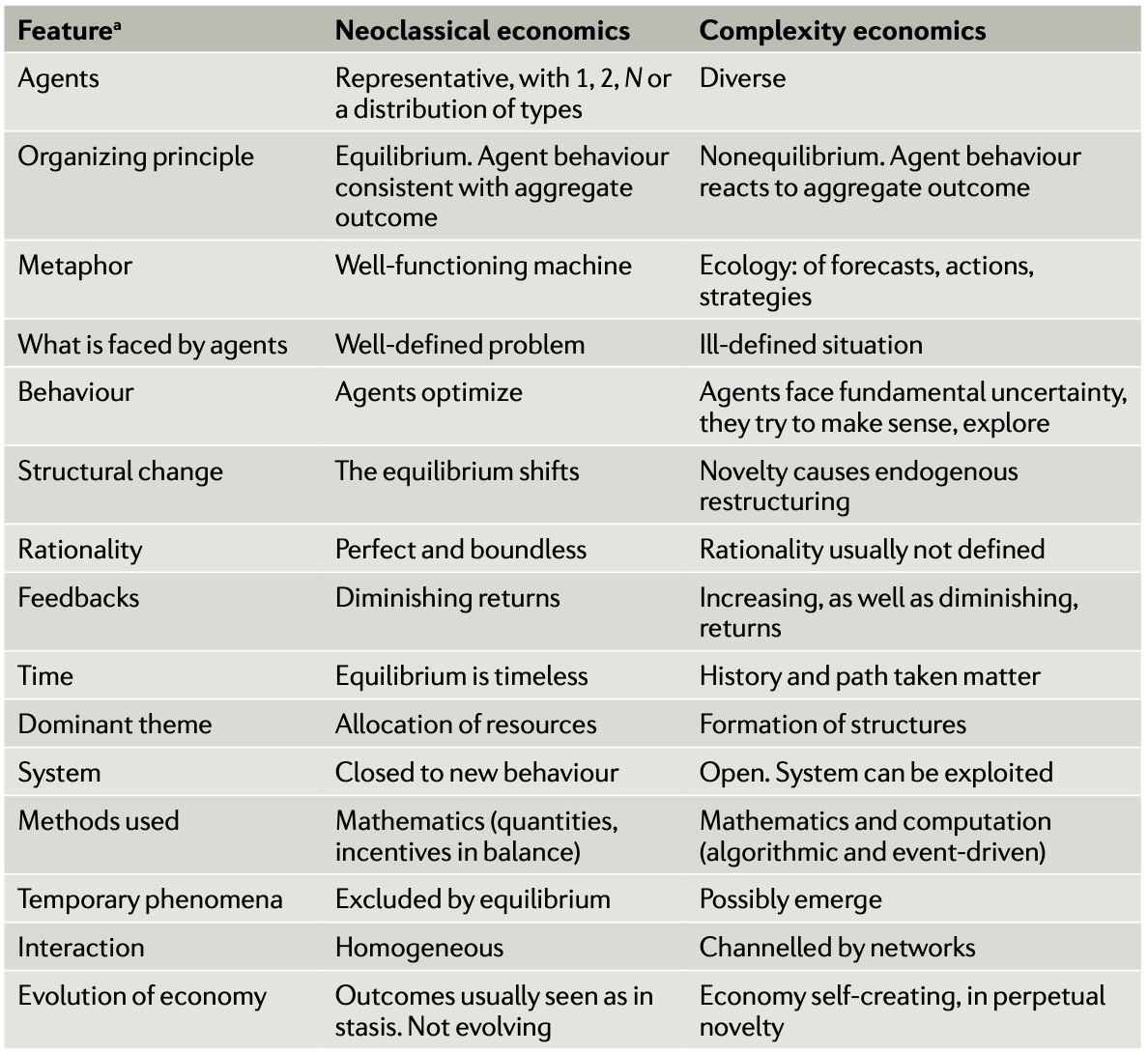
Arthur WB (2021) wrote a paper comparing conventional vs complexity economics.

Conventional neoclassical economics assumes:

  • Perfect rationality. It assumes agents each solve a well-defined problem using perfectly rational logic to optimize their behaviour.
  • Representative agents. It assumes, typically, that agents are the same as each other — they are ‘representative’ — and fall into one or a small number (or distribution) of representative types.
  • Common knowledge. It assumes all agents have exact knowledge of these agent types, that other agents are perfectly rational and that they too share this common knowledge.
  • Equilibrium. It assumes that the aggregate outcome is consistent with agent behaviour — it gives no incentive for agents to change their actions.

But over the past 120 years, economists such as Thorstein Veblen, Joseph Schumpeter, Friedrich Hayek, Joan Robinson, etc have objected to the equilibrium framework, each for their own reasons. All have thought a different economics was needed.

It was with this background in 1987 that the Santa Fe Institute convened a conference to bring together ten economic theorists and ten physical theorists to explore the economy as an evolving complex system.

Complexity economics sees the economy as not necessarily in equilibrium, its decision makers (or agents) as not superrational, the problems they face as not necessarily well-defined and the economy not as a perfectly humming machine but as an ever-changing ecology of beliefs, organizing principles and behaviours.

Complexity economics assumes that agents differ, that they have imperfect information about other agents and must, therefore, try to make sense of the situation they face. Agents explore, react and constantly change their actions and strategies in response to the outcome they mutually create. The resulting outcome may not be in equilibrium and may display patterns and emergent phenomena not visible to equilibrium analysis. The economy becomes something not given and existing but constantly forming from a developing set of actions, strategies and beliefs — something not mechanistic, static, timeless and perfect but organic, always creating itself, alive and full of messy vitality.

Difference between Neoclassical and Complexity Economics

In a complex system, the actions taken by a player are channelled via a network of connections. Within the economy, networks arise in many ways, such as trading, information transmission, social influence or lending and borrowing. Several aspects of networks are interesting: how their structure of interaction or topology makes a difference; how markets self-organize within them; how risk is transmitted; how events propagate; how they influence power structures.

The topology of a network matters as to whether connectedness enhances its stability or not. Its density of connections matters, too. When a transmissible event happens somewhere in a sparsely connected network, the change will fairly soon die out for lack of onward transmission; if it happens in a densely connected network, the event will spread and continue to spread for long periods. So, if a network were to slowly increase in its degree of connection, the system will go from few, if any, consequences to many, even to consequences that do not die out. It will undergo a phase change. This property is a familiar hallmark of complexity.

Reference: